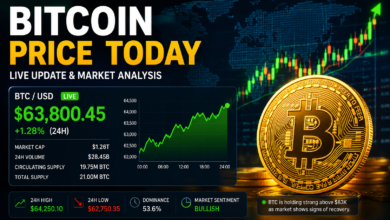
Bitcoin Nears $68,000 and Gold Jumps on US-Iran Tensions
Bitcoin nears $68,000 as gold prices jump amid escalating US-Iran tensions. Here's what it means for crypto and markets in 2026.

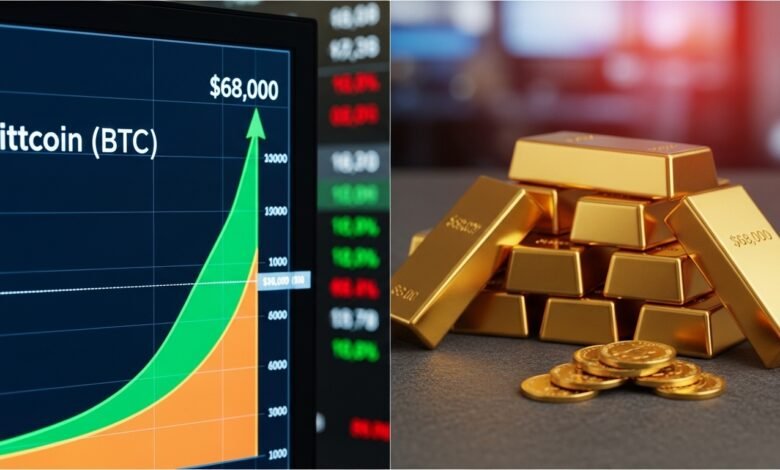
Bitcoin nears $68,000 as gold jumps on US-Iran tensions, and global financial markets are once again watching two of the world’s most closely tracked assets move in dramatically different directions. As of February 20, 2026, Bitcoin climbed toward the $68,000 threshold during Asian trading hours, riding what many analysts are calling a relief rally rather than a structural trend reversal. At the same time,
Bitcoin Nears $68,000 Gold Jumps US-Iran Tensions: What’s Driving the Move?
The week leading up to February 20, 2026, was anything but smooth for crypto markets. Bitcoin endured choppy price action, dipping below the $67,000 level at points before recovering as Asian markets opened on Friday morning. The bounce was broad across the cryptocurrency market, with XRP, Solana’s SOL, Dogecoin (DOGE), and Cardano’s ADA each adding up to 2% in the session. Ethereum, however, lagged, hovering just below the psychologically significant $2,000 level — a zone that traders have been treating more as a line to defend than a launching pad.
So what exactly is driving these movements? The answer lies at the intersection of two major forces: US-Iran geopolitical tensions and an unexpectedly hawkish tone from the Federal Reserve. The latest Fed meeting minutes revealed that policymakers put rate hikes back on the table if inflation fails to continue cooling. SynFutures COO Wenny Cai captured it well, noting that the key shift is not that hikes are now the base case — it is that the Fed has raised the bar significantly for near-term rate cuts. This has strengthened the U.S. dollar, tightened financial conditions, and pushed money back into short-duration Treasury bonds, draining some of the speculative appetite that had been fueling crypto markets in recent months.
How Geopolitical Risk Feeds Into Bitcoin’s Price Action
Geopolitical risk has always had a complex relationship with Bitcoin’s price. Unlike gold, which has centuries of cultural and institutional acceptance as a crisis hedge, Bitcoin’s role as a safe-haven asset remains contested. When Iran launched missile attacks on Israeli-aligned positions in previous months, Bitcoin actually fell while gold surged — a pattern that repeated itself during the latest US-Iran escalation. FxPro chief market analyst Alex Kuptsikevich remained bearish in his framing, warning that given the market’s prior dynamics and cautious U.S. stock tone, the probability of retesting 2024 lows has increased. He pointed to levels last seen in the second half of 2024 as a realistic downside scenario if selling pressure builds.
This is not to say that Bitcoin cannot benefit from geopolitical instability under the right conditions. J.P. Morgan analysts have previously argued that rising global tensions reinforce what some investors call the “debasement trade” — the idea that both gold and Bitcoin serve as hedges against currency devaluation driven by deficit spending and money printing. But in the short term, when fear dominates and liquidity is needed, institutional investors tend to reach for gold first.
Gold’s Record Run: Why the Yellow Metal Is Winning the Safe-Haven Race
While Bitcoin wrestled with uncertainty around the $68,000 mark, gold painted a far cleaner picture. Prices climbed past $5,000 per ounce, reflecting both the geopolitical risk premium from the US-Iran standoff and continued structural demand from central banks, institutional investors, and retail buyers globally. Ole Hansen, a widely followed commodities strategist, noted that the precious metals sector has been the primary beneficiary of heightened concerns about a potential US attack, with gold trading above $5,000 while silver and platinum also recorded meaningful gains.
Oil markets joined the rally, with both Brent crude and West Texas Intermediate contracts moving higher as traders priced in the possibility of supply disruptions through the Strait of Hormuz — the narrow waterway through which roughly one-fifth of the world’s oil supply flows daily. Even the mere perception of risk to this strategic chokepoint is historically sufficient to generate sharp price swings across energy and commodity markets.
Gold vs Bitcoin: The Safe-Haven Debate Intensified
The divergence between gold and Bitcoin during this period has reignited one of the most persistent debates in modern finance. Gold’s performance during the US-Iran tension spike reinforced its centuries-old role as the go-to store of value during crises. Bitcoin, by contrast, behaved more like a risk asset — correlating more closely with tech stocks and speculative positions than with gold. This behavioral split matters enormously for investors trying to determine how to allocate capital during periods of geopolitical uncertainty.
Research from CryptoQuant adds another layer of complexity. The firm reported that Bitcoin inflows from large holders to Binance have reached record levels — a pattern that historically precedes heavier spot supply hitting the market. When whales move Bitcoin to exchanges, it typically signals an intention to sell, which can cap any upside momentum even during recovery rallies. Combined with the broader risk-off sentiment across global markets, this data suggests the relief rally toward $68,000 could face significant resistance.
US-Iran Tensions and the Broader Macro Landscape
Understanding why Bitcoin nears $68,000 as gold jumps requires zooming out to see the full macroeconomic picture. The US-Iran standoff is not unfolding in isolation. It is layered on top of a Federal Reserve that is no longer as friendly to risk markets as it was in late 2024, a U.S. dollar that has strengthened on the back of hawkish Fed signals, and a global equity market navigating one of the weakest starts to a year on record for Bitcoin — which is on pace for its first-ever back-to-back declines in January and February.
President Trump’s public ultimatum giving Iran a narrow 10 to 15-day window for nuclear deal talks sent a clear message to markets: the risk of military escalation is real and immediate. Reports of expanded U.S. military presence in the region, combined with Israeli preparations for a scenario involving what analysts described as a potential weeks-long full-fledged war, have elevated the geopolitical risk premium embedded in oil, gold, and defensive assets to levels not seen in months.
What the Federal Reserve’s Hawkish Stance Means for Crypto
The Fed’s hawkish pivot — or at least its hawkish posturing — carries direct implications for cryptocurrency markets. When the cost of capital rises and the dollar strengthens, speculative assets like Bitcoin and Ethereum tend to face headwinds. Investors begin to discount the future value of assets that generate no yield, and the relative appeal of cash and bonds increases. This dynamic played out clearly in the week leading up to February 20, 2026, as money flowed back into short-duration Treasuries and out of higher-risk positions in both equities and crypto.
FxPro’s Kuptsikevich warned specifically that the cautious tone in U.S. stocks raises the odds of retesting the lows from the second half of 2024. For Bitcoin, that could mean a return to the $60,000 region — or even lower if the $65,000 support level fails to hold under continued selling pressure. Research firm K33 drew comparisons to the later stages of the 2022 bear market, which gave way to a long, grinding consolidation before any meaningful recovery took hold.
Bitcoin’s Technical Picture: Key Levels to Watch
From a pure technical analysis standpoint, Bitcoin’s current position near $68,000 places it in a critical zone. On the upside, $70,000 remains the key psychological and technical resistance level that bulls need to clear to signal a genuine trend reversal. On the downside, analysts have identified $65,000 as a near-term support zone, with $60,000 and $50,000 serving as deeper floors in the event of a more pronounced sell-off.
Ethereum’s situation is similarly precarious. The token is sitting on a long-running support line that traces back to 2020 and aligns with the $2,000 area. A breakdown below this level — confirmed by a sustained close beneath $1,500 — would represent a serious structural deterioration. The fact that the market has been treating $2,000 as a defensive wall rather than a base for higher prices speaks volumes about current market sentiment.
Bitcoin mining difficulty also hit a notable milestone this week, rising to 144.4T — a 15% jump that represents the biggest percentage increase since 2021. While higher mining difficulty is generally a positive long-term signal reflecting increased network security and miner confidence, it also adds to operational costs for miners in the short term, which can contribute to sell pressure if Bitcoin’s price doesn’t keep pace.
Altcoin Performance During the US-Iran Tension Spike
While Bitcoin dominated the headlines, altcoins offered a more nuanced picture. The broad bounce in XRP, Solana, Dogecoin, and Cardano suggested that the crypto market retained some risk appetite even amid the geopolitical turmoil. However, these gains were modest — largely in the 1% to 2% range — and felt more like relief trades than conviction-driven rallies. Ethereum’s underperformance relative to its peers reinforced the idea that the market continues to reward higher-beta bets over more established plays when risk appetite is fragile.
Investor Strategy: Navigating Bitcoin, Gold, and Geopolitical Risk
For investors watching Bitcoin nears $68,000 as gold jumps on US-Iran tensions, the key question is how to position in an environment where traditional safe havens and speculative assets are pulling in opposite directions. Several themes emerge from this week’s market action.
First, diversification between Bitcoin and gold remains relevant. The divergence between the two assets during periods of acute geopolitical stress suggests that holding both may provide better risk-adjusted outcomes than concentrating exclusively in either. Gold provides crisis insurance, while Bitcoin offers asymmetric upside in calmer macro environments.
Second, the Federal Reserve’s policy trajectory will be a dominant driver of crypto market performance through the first half of 2026. Any softening in the Fed’s tone — driven by weaker inflation data or a deterioration in the labor market — could quickly shift the narrative back in favor of risk assets, including Bitcoin.
Third, the US-Iran situation bears watching closely over the next two to four weeks. If diplomatic channels through Oman or Geneva yield a breakthrough, a swift relief rally across risk assets is plausible. Conversely, further military escalation could push investors even deeper into gold, oil, and defensive equities, leaving Bitcoin and altcoins to absorb additional selling pressure.
Conclusion
The story of Bitcoin nearing $68,000 as gold jumps on US-Iran tensions is not just a snapshot of one volatile week in crypto and commodities markets. It is a reminder of the complex, interconnected forces that drive asset prices in an era of geopolitical instability, shifting monetary policy, and evolving investor behavior. Whether you are a long-term Bitcoin holder, a gold investor, or simply someone trying to understand the macro forces shaping global markets in 2026, staying informed has never been more important.
The next 48 to 72 hours will be critical. Watch the $65,000 Bitcoin support level, track diplomatic developments between the U.S. and Iran, and pay close attention to upcoming PCE inflation data that could further clarify the Fed’s policy path. If you want to stay ahead of fast-moving developments in Bitcoin, gold, and geopolitical risk, bookmark this page and follow live market updates. Whether you are deciding how to hedge your portfolio or simply trying to understand the big picture, now is the time to do your research, consult a qualified financial advisor, and act with a clear strategy.
See more;