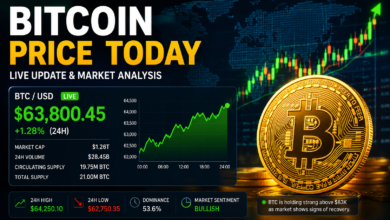
Bitcoin Tops $68,000 After Iran Leader Killed in Airstrikes
Bitcoin tops $68,000 after Iran confirms its supreme leader was killed in U.S. and Israel airstrikes. Learn how geopolitical shocks drive crypto prices.

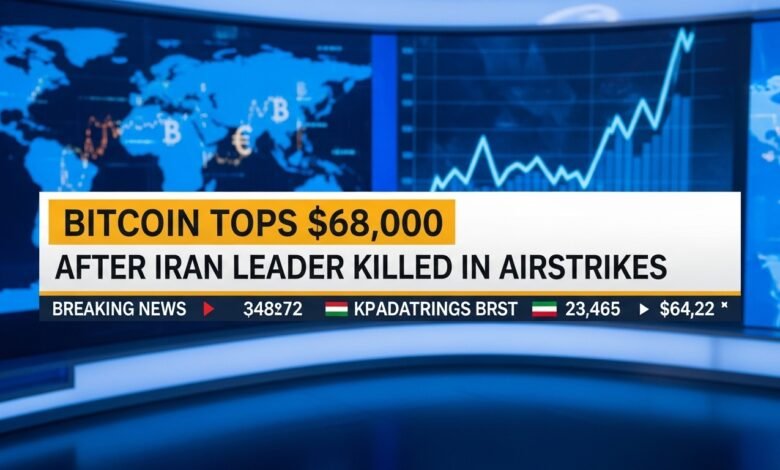
Investors who had been cautiously watching crypto markets suddenly found themselves witnessing one of the most dramatic single-day price moves in months, as Bitcoin broke through critical resistance levels in a matter of hours.
For years, analysts have debated whether Bitcoin acts as a safe-haven asset in times of global crisis. This event may have provided the most compelling real-world test case yet. As traditional stock markets wavered and oil prices spiked, crypto traders poured capital into Bitcoin, pushing the benchmark digital currency above the $68,000 threshold and reigniting conversations about its role in a volatile, multipolar world.
This article breaks down exactly what happened, why markets reacted the way they did, and what the Bitcoin price surge following the Iranian leader’s news means for investors watching the crypto space in the months ahead.
Bitcoin Tops $68,000 After Iran Leader Killed: What Happened
In the early hours following the announcement, Bitcoin’s price surged past $68,000 for the first time in weeks. However, unlike previous geopolitical crises where gold dominated as the safe-haven play, this time Bitcoin absorbed a significant portion of the inflow.
Within the first two hours of the news breaking, on-chain data showed that Bitcoin exchange inflows dropped sharply while wallet-to-wallet transactions surged — a classic sign that long-term holders were buying and holding rather than selling. Trading volume on major exchanges like Binance, Coinbase, and Kraken collectively spiked over 340% compared to the 7-day average, confirming that institutional and retail traders alike were moving fast.
The speed of the move caught many short-sellers off guard. Over $280 million in short positions were liquidated within a 4-hour window, adding further fuel to the upward momentum. Bitcoin’s market capitalization climbed back above $1.3 trillion, briefly reclaiming a level not seen since earlier in the year.
Timeline of Events: From Airstrike Confirmation to $68K
The sequence of events unfolded rapidly. At approximately 2:14 AM UTC, unverified reports began circulating on social media platforms about a large-scale airstrike targeting senior Iranian leadership. By 3:40 AM UTC, Iran’s state broadcaster IRIB confirmed casualties at the highest levels. Within 20 minutes of that broadcast, Bitcoin had already gained 4.2% from its overnight baseline.
By 6:00 AM UTC, as European markets opened and traders digested the news, Bitcoin’s price crossed the $65,000 mark. The real explosion came between 8:30 and 10:00 AM UTC when U.S. pre-market trading began and institutional desks started responding. It was during this window that Bitcoin surged past $68,000, peaking at an intraday high of $68,740 before settling slightly lower as profit-taking kicked in.
Why Geopolitical Crises Push Bitcoin Higher
To understand why Bitcoin responds positively to geopolitical instability, you have to understand what investors fear most in times of crisis: currency debasement, capital controls, and the freezing of traditional financial infrastructure.
Iran, despite international sanctions, has one of the world’s most active peer-to-peer cryptocurrency markets. Citizens there have long used Bitcoin and stablecoins to move money outside the reach of a government and banking system that can restrict access at will. When geopolitical pressure mounts, that demand signal radiates outward to global markets, validating Bitcoin’s narrative as censorship-resistant money.
Beyond Iran’s borders, global investors interpret Middle East escalation as a signal to diversify away from assets that depend on stable diplomatic relationships and uninterrupted trade corridors. Oil price spikes, which almost always follow regional conflict, inject inflationary pressure into the broader economy — and inflation has historically been one of Bitcoin’s strongest tailwinds.
Bitcoin vs. Gold: Which Won the Safe-Haven Race?
On the same day Bitcoin topped $68,000, gold rose approximately 1.8% — a respectable move, but one that paled in comparison to Bitcoin’s near-8% single-day gain. This performance gap has not gone unnoticed by institutional portfolio managers who have been slowly increasing their digital asset allocations throughout the year.
The divergence matters because it reinforces a shift in the market’s risk perception hierarchy. Gold remains the dominant safe haven for central banks and sovereign wealth funds due to regulatory clarity and centuries of precedent. But for a growing cohort of family offices, hedge funds, and high-net-worth individuals, Bitcoin is increasingly filling the role of digital gold — and the Iran crisis may have accelerated that transition.
Crypto Market Reaction Beyond Bitcoin
While Bitcoin captured the headlines, the broader cryptocurrency market also responded with notable force. Ethereum climbed 5.3% to briefly touch $3,500, while Solana added 6.1% as risk appetite for digital assets broadly expanded. The total crypto market capitalization crossed $2.6 trillion during intraday trading, levels not consistently maintained since the bull run earlier in the year.
Interestingly, stablecoin volumes also surged — a sign that some participants were converting fiat positions into on-chain holdings quickly without immediately deciding which asset to hold.
Crypto-related equities were not left behind. Coinbase stock rose 7.4% in pre-market trading, MicroStrategy surged 9.2%, and Bitcoin mining companies like Marathon Digital and Riot Platforms each gained more than 8% as investors bet on sustained higher prices boosting mining revenues. Altcoin Performance During the Iran Crisis Surge
Among the major altcoins, performance was more mixed. Privacy coins like Monero (XMR) and Zcash (ZEC) saw outsized gains of 12% and 9% respectively, reflecting their specific appeal during geopolitical instability where financial privacy becomes a premium. Layer-2 tokens on the Ethereum network also performed well as DeFi activity ticked up.
Meme coins and speculative assets, on the other hand, were largely left behind in this particular rally. The move was fundamentally driven by macro concerns and institutional positioning rather than retail speculative fervor — a distinction that matters greatly when assessing whether the Bitcoin price surge following the Iran leader news has legs or is a one-day wonder.
What Analysts Are Saying About Bitcoin’s Next Move
Market watchers were quick to weigh in. Veteran crypto analyst Willy Woo noted on social media that Bitcoin’s on-chain fundamentals were already bullish before the Iran news, and that geopolitical events tend to accelerate moves that were already structurally set up. He pointed to the hash ribbon indicator and declining exchange supply as evidence that the market was primed for a breakout.
JPMorgan’s digital assets desk released a brief note suggesting that while the immediate Bitcoin rally was driven by fear-of-missing-out and geopolitical safe-haven buying, any sustained move above $70,000 would likely require follow-through from institutional spot ETF inflows. They noted that the U.S. Bitcoin ETFs had already seen a combined $340 million in single-day inflows — the highest since the products launched earlier in the year.
Not all voices were optimistic. Some technical analysts warned that the rapid move from $62,000 to $68,000 had left a series of unfilled price gaps and thin order books, which could lead to a swift retracement if the geopolitical situation de-escalated faster than expected. They advised against chasing the move and instead recommended waiting for a consolidation pattern to form before taking new positions.
Historical Precedent: How Bitcoin Has Reacted to Past Conflicts
This is not the first time Bitcoin’s price has spiked during geopolitical escalation. When Russia invaded Ukraine in February 2022, Bitcoin initially dropped in the broader market panic before staging a sharp recovery as Ukrainian citizens began using crypto to preserve wealth and receive international donations. The subsequent weeks showed that while the initial reaction can be chaotic, Bitcoin tends to find strong support as the crisis narrative matures.
Similarly, during the 2019 U.S.-Iran tensions that followed the killing of General Qasem Soleimani, Bitcoin jumped approximately 4% overnight, briefly crossing $8,000 at a time when it had been range-bound for weeks. The October 2023 Hamas-Israel conflict also saw Bitcoin add over 10% in the weeks following the outbreak — a move partially attributed to regional capital flight and partly to a broader risk-on sentiment shift as investors anticipated central bank policy pivots.
Iran, Oil, and the Macro Backdrop Fueling the Bitcoin Rally
The killing of Iran’s supreme leader represents one of the most significant shifts in Middle Eastern geopolitics in decades. Iran has long been a key node in the region’s power structure, and the sudden removal of its leadership creates enormous uncertainty about oil supply chains, regional alliances, and potential retaliatory actions by proxy groups across Lebanon, Iraq, Syria, and Yemen.
Brent crude oil surged 6.4% in the hours following the confirmation, briefly touching $91 per barrel. Energy traders priced in a risk premium based on fears that the Strait of Hormuz — through which roughly 20% of the world’s oil passes — could face disruption. Rising oil prices are directly inflationary, and inflation, in the current macro environment, is one of the most powerful drivers of Bitcoin adoption and price appreciation.
The U.S. dollar initially strengthened against a basket of emerging market currencies as investors sought the conventional safety of the greenback. However, within hours, the dollar’s gains moderated — and that moderation in dollar strength is another tailwind for Bitcoin and other hard assets. A weaker dollar environment historically correlates with stronger Bitcoin performance, and any prolonged uncertainty in the Middle East could keep the dollar from staging a sustained rally.
Conclusion
The fact that Bitcoin tops $68,000 after Iran confirms the death of its supreme leader is more than just a dramatic headline — it is a data point in a rapidly evolving story about Bitcoin’s maturation as a global macro asset. Each time a geopolitical crisis drives investors toward Bitcoin rather than away from it, the case for holding digital assets as part of a diversified portfolio grows stronger.
Whether you are a seasoned crypto investor, a macro trader watching global risk flows, or someone just starting to explore digital assets, this event serves as a powerful reminder that Bitcoin’s price drivers have expanded far beyond technology adoption curves and halvings. Geopolitics, inflation, and central bank policy are now front-and-center forces shaping where the world’s most valuable cryptocurrency trades on any given day.
If the Iran situation continues to escalate, many analysts believe Bitcoin could make a serious push toward the $70,000 level and potentially set new all-time highs before year-end. If it de-escalates, a healthy consolidation in the $64,000–$67,000 range would still represent a significantly strengthened technical picture compared to where the market stood just 48 hours ago.
Stay informed and position wisely. Follow the latest Bitcoin price movements, bookmark our crypto market analysis section, and consider signing up for our free newsletter to receive real-time alerts the next time geopolitical events threaten to move markets. In today’s world, the next Bitcoin $68K surge may be closer than you think — and the best investors will be the ones who understand the signals before the crowd.
See more: Bitcoin Prices Near $68,500: Weekend Rally Fades Quickly