The Ripple Effect: How XRPL’s Brazil Partnership and RLUSD Are Driving the XRP Surge!
How the XRPL Brazil partnership and RLUSD shape the XRP story

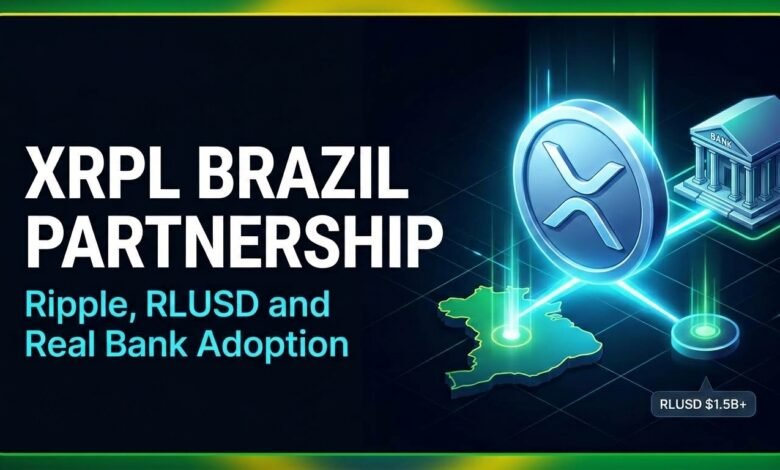
The XRPL Brazil partnership has put Ripple’s technology at the center of one of Latin America’s biggest financial markets. In March 2026, Ripple launched a full financial stack in Brazil that covers payments, custody, and its RLUSD stablecoin. Local banks and fintech firms already use the XRP Ledger to move real money, and traders now ask whether this adoption will push XRP higher. The answer is more complex than the headlines suggest. In this guide, we explain what Ripple built, how RLUSD fits in, how XRP gains from the system, and which risks investors should weigh before they buy.
What Is the XRPL Brazil Partnership?
The XRPL Brazil partnership describes the growing cooperation between Ripple, the XRP Ledger,r and Brazilian financial companies. Ripple first explored the Brazilian market in 2020. In 2024, it launched payment services there through a partnership with Mercado Bitcoin. Since then, banks and fintech firms have joined the network, and Brazilian issuers now create local stablecoins directly on the XRP Ledger. Brazil makes a smart target because local currency prices swing often, and businesses want faster and cheaper cross-border payments. You can read more about the technology on the official XRP Ledger website.
What Ripple Launched in Brazil in March 2026
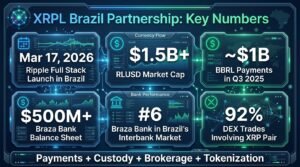
On March 17, 2026, Ripple announced one of its biggest single-market rollouts. The company brought payments, custody, brokerage, and tokenization tools to Brazil at the same time. Two companies already use Ripple Custody to tokenize real-world assets on the XRP Ledger. Ripple also said it plans to apply to Brazil’s central bank for regulatory approval, which would let it offer regulated services. This move turns Ripple from a payment technology provider into a full infrastructure partner for banks. Institutions can now access several services through one connected platform instead of many separate vendors.
How RLUSD Powers the Brazil Plan
RLUSD, Ripple’s dollar-backed stablecoin, ties the whole platform together. Banks and businesses prefer stable money for settlement, because they cannot accept sudden price swings in the middle of a payment. RLUSD gives them a digital dollar that moves in seconds on the XRP Ledger and on Ethereum. Its market cap has passed $1.5 billion since the December 2024 launch, and exchanges keep adding new trading pairs. Ripple also teams up with firms such as Revolut, Zero Hash,h and Chainlink to widen access. This growth shows that institutions trust the product, even though it does not directly raise the price of XRP.
Braza Bank, BBRL and Real Usage on the Ledger
Braza Bank gives the XRPL Brazil partnership one of its strongest proof points. The bank issues BBRL, a Brazilian real stablecoin, directly on the XRP Ledger. Reports say BBRL processed about $1 billion in customer payments during the third quarter of 2025. The bank holds a balance sheet above $500 million and ranks sixth in Brazil’s interbank market. These numbers show real payment flow rather than pilot projects or press releases. When a regulated bank chooses the XRP Ledger for local currency payments, other institutions notice and often start their own tests.
How XRP Auto-Bridging Connects Everything
Many readers ask where XRP fits when Ripple’s own announcement focused on RLUSD. The answer is auto-bridging on the XRP Ledger’s built-in decentralized exchange. When a user trades BBRL for RLUSD, the system can use XRP as a bridge between the two tokens. Neither trader needs to buy or hold XRP, yet the asset still carries the trade. On-chain data from validator Vet shows that 92 percent of trades on the ledger’s exchange already involve a token and XRP pair. This design gives XRP a quiet role in every cross-token payment.
Is the XRP Surge Real?
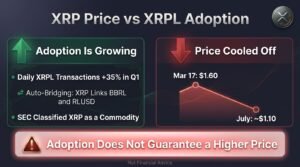
The title promises a surge, but the data tells a more careful story. XRP touched $1.60 on March 17, the same day Ripple announced the Brazil launch and the SEC classified XRP as a commodity. After that, the price cooled, and it traded near $1.10 in July. Analysts point out that no Ripple partnership has moved the price much this year, even though network usage keeps growing. Daily transactions on the XRP Ledger rose 35 percent in the first quarter, while the token fell. Always check the live XRP price before you make any decision.
Risks Behind the XRPL Brazil Partnership
Strong adoption does not guarantee a higher price. Some market watchers fear that RLUSD could eventually replace XRP in bank settlements, although Ripple partner Evernorth insists the two assets are not substitutes. Brazil’s central bank has not yet approved Ripple’s license request, so regulation can slow the rollout. Competing stablecoins and blockchains also fight for the same institutional clients. Traders who use leverage face fast losses when headlines fail to move the market. Treat every announcement with caution, never invest more than you can afford to lose, and read the full story on Cope Bitcoin. This is not financial advice.
FAQs About the XRPL Brazil Partnership
What is the XRPL Brazil partnership?
It describes Ripple’s expansion in Brazil, where banks and fintech firms use the XRP Ledger for payments, custody, tokenization, and stablecoins such as RLUSD and BBRL.
Does RLUSD increase the XRP price?
Not directly. RLUSD grows the ledger’s activity, but banks mainly use it for stable settlement. XRP benefits only when trades route through it.
Did the Brazil launch cause an XRP surge?
XRP hit $1.60 on the launch day, but it cooled afterward. Analysts say no Ripple partnership has driven a lasting rally this year.
What is BBRL on the XRP Ledger?
BBRL is a Brazilian real stablecoin that Braza Bank issues on the XRP Ledger. It reportedly processed about $1 billion in payments in the third quarter of 2025.
Is XRP a safe investment?
No crypto asset is risk-free. Prices swing sharply, regulation keeps changing, and competition grows. Research carefully before you invest.
Final Thoughts on the XRPL Brazil Partnership
The XRPL Brazil partnership shows that Ripple wants real banking customers, not only crypto traders. RLUSD brings stable money, BBRL brings local currency, and XRP quietly links them through auto-bridging. The price has not followed the news yet, so patience matters more than hype. Watch RLUSD growth, central bank approval, and ledger activity over the coming months. For a deeper look at this story, read this market analysis on Ripple’s Brazil launch, and keep following daily updates at Cope Bitcoin.