Bitcoin Price Rises 2%; Whale Moves 5,152 BTC – Volatility Ahead
Bitcoin price rises 2% as major whale moves 5,152 BTC. Discover what this means for crypto markets and why volatility is expected ahead.

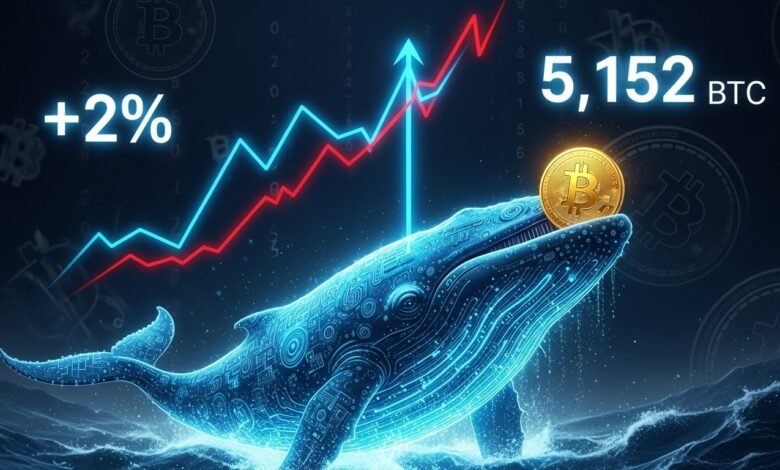
Bitcoin price rises by 2%, reaching new intraday highs while simultaneously a major whale moved 5,152 BTC worth approximately $524 million. This dual occurrence has sparked intense speculation among traders and analysts about what lies ahead for the world’s leading digital asset. When large holders, commonly referred to as whales, execute substantial transactions, the ripple effects throughout the market can be profound. The recent Bitcoin price rises whale moves scenario presents a fascinating case study in market dynamics, institutional behavior, and the delicate balance between bullish momentum and potential corrections. As we analyze these developments, understanding the correlation between whale activity and price movements becomes crucial for anyone invested in or tracking cryptocurrency markets. The coming days and weeks may prove pivotal as market participants digest these signals and position themselves accordingly for the anticipated volatility.
Understanding the Recent Bitcoin Price Movement
The cryptocurrency market has demonstrated remarkable resilience as the Bitcoin price rises by 2% in the past 24 hours. This upward trajectory comes at a critical juncture when many analysts were predicting a period of consolidation. The price increase pushed Bitcoin beyond key resistance levels that had been holding since early December, signaling renewed confidence among buyers and potentially marking the beginning of a more sustained rally.
Market participants have been closely monitoring several factors contributing to this price appreciation. Trading volumes increased by approximately 18% during the rally, indicating genuine buying pressure rather than low-liquidity pumps. The derivatives market also showed interesting dynamics, with funding rates turning positive and open interest climbing, suggesting that leveraged traders are betting on continued upside momentum.
What makes this particular price movement noteworthy is its timing relative to broader macroeconomic conditions. Despite ongoing concerns about interest rates and regulatory scrutiny in various jurisdictions, Bitcoin has managed to carve out its own narrative. The 2% gain might seem modest compared to the explosive rallies cryptocurrency veterans remember, but in the current market environment, such steady appreciation often proves more sustainable than violent price spikes.
Technical analysts point to several chart patterns supporting the bullish case. The recent bounce from support levels created a higher low compared to previous corrections, and the relative strength index has moved into favorable territory without entering overbought conditions. These technical factors, combined with improving on-chain metrics, paint a picture of gradual but healthy accumulation.
The Significance of the 5,152 BTC Whale Transaction
When a whale moves 5,152 BTC, the entire cryptocurrency community takes notice. This particular transaction, valued at over half a billion dollars at current market prices, represents one of the more substantial movements tracked by blockchain analytics platforms in recent weeks. Understanding whale behavior is essential because these large holders can influence market dynamics through their actions, whether intentional or not.
Blockchain data reveals that the Bitcoin was moved from a wallet that had remained dormant for several months, suggesting this was not part of regular trading activity but rather a more strategic repositioning. The destination addresses show the funds were split across multiple wallets, a common practice for whales looking to either distribute risk, prepare for over-the-counter trades, or position for strategic deployment.
Historical analysis of whale movements shows mixed implications for short-term price action. In some cases, large transfers to exchanges precede selling pressure as whales liquidate positions. However, movements to cold storage or new accumulation addresses often signal long-term confidence. The current transfer shows characteristics of the latter, with funds moving into newly created addresses rather than exchange wallets, potentially indicating that this whale is repositioning rather than preparing to sell.
The timing of this whale activity coinciding with the Bitcoin price rises creates an interesting dynamic. Some market observers suggest that sophisticated large holders often move funds during periods of positive price action to mask their activities amid higher overall trading volumes. Others interpret such movements as confidence signals, with whales repositioning their holdings in anticipation of further appreciation.
What remains clear is that whale watching has become an integral part of cryptocurrency market analysis. These large holders, who collectively control significant portions of Bitcoin’s circulating supply, wield considerable influence. Their movements provide valuable insights into market sentiment among the most informed and capitalized participants.
Analyzing the Correlation Between Whale Activity and Price Volatility
The relationship between whale movements and subsequent market volatility ahead represents one of the most studied phenomena in cryptocurrency markets. This pattern holds regardless of whether the initial price reaction is positive or negative. The mechanism behind this increased volatility involves several factors, including the impact on order books, the psychological effect on retail traders, and the strategic responses of other large holders who may adjust their positions based on perceived whale intentions.
The current scenario presents particularly interesting conditions because the whale movement occurred during an uptrend rather than a consolidation phase. Historically, whale activity during price appreciation can either accelerate the rally if interpreted as accumulation or trigger profit-taking if viewed as distribution. The split nature of the recent transaction, with Bitcoin moving to multiple addresses, complicates the interpretation and may contribute to heightened uncertainty.
Derivatives markets often provide early warning signs of impending volatility following whale transactions. Options traders typically bid up the prices of both calls and puts when major movements are detected, reflecting uncertainty about direction but certainty about increased movement. Current options data shows elevated implied volatility for near-term contracts, confirming that professional traders are positioning for significant price action.
The broader context of market liquidity also plays a crucial role in determining how whale movements translate to volatility. During periods of thin liquidity, even moderate whale activity can cause exaggerated price swings. Current market conditions show reasonable liquidity across major exchanges, which may help absorb some of the potential impact, though vigilance remains warranted.
Market Sentiment and Technical Indicators
As the Bitcoin price rises whale moves narrative unfolds, examining market sentiment and technical indicators provides crucial context for understanding potential future trajectories. The Fear and Greed Index, a popular cryptocurrency sentiment gauge, has moved into neutral to slightly greedy territory, suggesting that optimism is building but hasn’t reached euphoric levels that typically mark local tops.
On-chain metrics paint a nuanced picture of market health. The number of addresses holding more than one Bitcoin has reached new highs, indicating continued accumulation by smaller whales and retail investors. Network activity, as measured by transaction count and active addresses, shows steady growth without the explosive spikes that sometimes precede corrections. These fundamentals suggest underlying strength in the ecosystem beyond just price speculation.
Technical analysis reveals that Bitcoin is testing significant resistance levels that have capped previous rallies. The 50-day moving average has crossed above the 200-day moving average in what technical analysts call a golden cross, traditionally viewed as a bullish long-term signal. However, short-term momentum indicators show the rally may be entering overbought territory, which could justify a healthy pullback before continuation.
Exchange flows provide another dimension of analysis. Data shows net outflows from major exchanges over the past week, meaning more Bitcoin is being moved into private wallets than deposited for trading. This typically indicates holders are positioning for longer-term storage rather than immediate selling, a bullish sign that aligns with the accumulation narrative suggested by the recent whale movement.
Social media sentiment analysis reveals increasing discussion volume around Bitcoin, with positive mentions outweighing negative ones by a significant margin. However, the tone remains cautiously optimistic rather than euphoric, suggesting the market has not yet entered the extreme greed phase that characterizes tops. This measured sentiment could support continued gradual appreciation rather than a blow-off top.
Institutional Involvement and Its Impact on Bitcoin Prices
The evolution of institutional participation in cryptocurrency markets has fundamentally altered the dynamics of how Bitcoin price rises and falls. Major financial institutions, hedge funds, and publicly traded companies now hold significant Bitcoin positions, bringing both legitimacy and new volatility drivers to the market. Their involvement has created a more sophisticated trading environment where traditional finance meets digital asset innovation.
Recent quarters have seen continued institutional accumulation despite regulatory uncertainties and market volatility. Publicly disclosed holdings by companies like MicroStrategy, Tesla, and various Bitcoin ETFs represent billions of dollars in committed capital. These positions are typically held for strategic purposes rather than short-term trading, providing a foundation of demand that supports price levels during corrections.
The approval and growth of Bitcoin spot ETFs has created new channels for institutional and retail investment. These products allow traditional investors to gain Bitcoin exposure without dealing with custody concerns, dramatically lowering the barrier to entry. Trading volumes in Bitcoin ETFs have grown substantially, with daily flows providing real-time insight into investor sentiment from the traditional finance world.
Institutional trading strategies differ significantly from retail behavior, often involving sophisticated hedging techniques and multi-venue execution. When institutions decide to adjust positions, their trades typically occur through over-the-counter desks to minimize market impact. However, the settlement of these trades can still appear on-chain as large whale movements, potentially explaining some of the activity we’re currently observing.
The integration of Bitcoin into traditional portfolio management strategies continues to advance. Financial advisors increasingly recommend small allocations to cryptocurrency as part of diversified portfolios, creating steady demand that supports baseline prices. This maturation of the market suggests that while volatility remains higher than traditional assets, Bitcoin is establishing itself as a legitimate portfolio component.
Regulatory Landscape and Its Influence on Market Dynamics
The regulatory environment surrounding cryptocurrency continues to evolve and exerts significant influence on market behavior when the Bitcoin price rises whale moves situations occur. Different jurisdictions are taking varied approaches to digital asset regulation, creating a patchwork of rules that market participants must navigate. Understanding these regulatory dynamics is essential for anticipating potential market movements and volatility.
Recent developments in the United States show a more nuanced regulatory approach compared to previous years. The Securities and Exchange Commission has provided greater clarity around certain aspects of cryptocurrency trading and custody, while still maintaining strict oversight of tokens deemed to be securities. This regulatory evolution affects how institutions handle large Bitcoin transactions and report their holdings, potentially influencing the timing and structure of whale movements.
International regulatory developments also play crucial roles in Bitcoin market dynamics. The European Union’s Markets in Crypto Assets regulation has established comprehensive frameworks for cryptocurrency operations, potentially influencing how European whales structure their transactions. Asian markets, particularly in jurisdictions like Singapore and Hong Kong, are developing their own regulatory approaches that balance innovation with consumer protection.
The impact of regulatory announcements on Bitcoin volatility cannot be overstated. Major policy pronouncements often trigger immediate price reactions as markets digest implications for institutional participation, taxation, and operational requirements. Sophisticated whales monitor these developments closely and may adjust their positions in anticipation of regulatory changes, contributing to the movements we observe on-chain.
Compliance requirements for large holders and institutions have increased substantially. Know Your Customer and Anti-Money Laundering regulations require detailed reporting of significant transactions, which may explain why whales increasingly split large movements across multiple transactions and wallets. This regulatory adaptation continues to shape how large holders operate and interact with the broader market.
Future Outlook and Potential Scenarios
Looking ahead at what the combination of Bitcoin price rises and whale activity might mean for future market development requires examining multiple potential scenarios. Supporting this view are improving macroeconomic conditions, growing institutional adoption, and technical indicators suggesting room for upward movement. Should this scenario play out, price targets in the $110,000 to $120,000 range become feasible within coming months.
A consolidation scenario suggests that Bitcoin may trade sideways for an extended period as markets digest recent gains and await catalysts for the next major move. Under this framework, the whale movement represents portfolio rebalancing rather than directional betting, and short-term volatility gives way to range-bound trading. This outcome might frustrate momentum traders but could provide opportunities for strategic accumulation at stable prices.
The bearish scenario, while less popular among current market participants, remains possible if the whale movement presages distribution rather than accumulation. Should large holders begin systematic selling, the thin order books on exchanges could amplify downward pressure. Combined with potential negative catalysts like adverse regulatory developments or macroeconomic deterioration, this could trigger a correction that tests lower support levels.
Most likely, the coming weeks will feature elements of all these scenarios as markets work to establish a new equilibrium. Volatility ahead appears certain regardless of ultimate direction, with the interplay between whale activity, institutional flows, retail sentiment, and external factors creating a dynamic environment requiring careful navigation.
Strategies for Navigating Potential Volatility
For market participants seeking to navigate the anticipated volatility ahead, developing robust strategies becomes paramount. The combination of rising prices and significant whale activity creates both opportunities and risks that require thoughtful approaches. Whether you’re a long-term holder, active trader, or institutional investor, understanding how to position yourself in uncertain markets can make the difference between success and disappointment.
Risk management should form the cornerstone of any strategy when Bitcoin price rises whale moves scenarios unfold. This includes setting clear stop-loss levels, sizing positions appropriately relative to overall portfolio value, and maintaining discipline about taking profits at predetermined levels. Many experienced traders reduce position sizes during periods of elevated uncertainty, preferring to accept smaller gains in exchange for protection against unexpected reversals.
Dollar-cost averaging strategies can help investors navigate volatility by removing the pressure of timing perfect entries. By systematically purchasing fixed dollar amounts regardless of price, investors build positions while avoiding the emotional decision-making that often leads to buying tops and selling bottoms. This approach proves particularly effective during volatile periods when predicting short-term direction becomes nearly impossible.
For more active traders, utilizing technical analysis and respecting key support and resistance levels helps frame risk-reward scenarios. The recent whale movement and price appreciation have established new reference points that may guide future trading ranges. Paying attention to volume patterns, momentum indicators, and order book dynamics can provide early warnings of potential trend changes.
Diversification across different cryptocurrencies and traditional assets remains a fundamental principle for managing portfolio risk. While Bitcoin dominates cryptocurrency markets, maintaining exposure to other digital assets and traditional investments can cushion against Bitcoin-specific volatility. This balanced approach allows participation in upside potential while limiting downside exposure.
Conclusion
The convergence of Bitcoin price rises whale moves and anticipated volatility creates a pivotal moment for cryptocurrency markets. The 2% price increase combined with the movement of 5,152 BTC by a major whale signals that significant market forces are positioning for the next phase of Bitcoin’s evolution. Whether these developments herald the beginning of a major rally or merely represent tactical repositioning ahead of consolidation remains to be seen, but the importance of staying informed and prepared cannot be overstated.
As we’ve explored throughout this analysis, multiple factors will influence how this situation unfolds. Technical indicators suggest potential for continued appreciation, but also warn of overbought conditions that could justify pullbacks. On-chain metrics show healthy accumulation patterns, while whale activity introduces uncertainty about near-term direction. Institutional involvement continues to mature, bringing both stability and new volatility drivers to the market.
For those looking to participate in Bitcoin markets during this dynamic period, maintaining a balanced perspective between opportunity and risk proves essential. The cryptocurrency space rewards preparation, discipline, and patience while punishing emotional decision-making and excessive leverage. Whether you’re a seasoned trader or new to digital assets, focusing on sound principles of risk management and continuous learning will serve you well.
Stay informed about Bitcoin price rises whale moves and market developments by following reputable analytics platforms, setting up on-chain alerts for significant transactions, and maintaining awareness of broader macroeconomic and regulatory factors. The coming weeks promise to deliver valuable insights into Bitcoin’s trajectory and the health of cryptocurrency markets more broadly. Position yourself thoughtfully, manage your risk carefully, and remember that in volatile markets, survival often matters more than capturing every opportunity.