IBIT Among Most-Traded ETFs as Bitcoin Jumps
BlackRock’s IBIT spot Bitcoin ETF leads trading as BTC rebounds, while Bitcoin mining stocks lag. Here’s what this divergence means for investors.

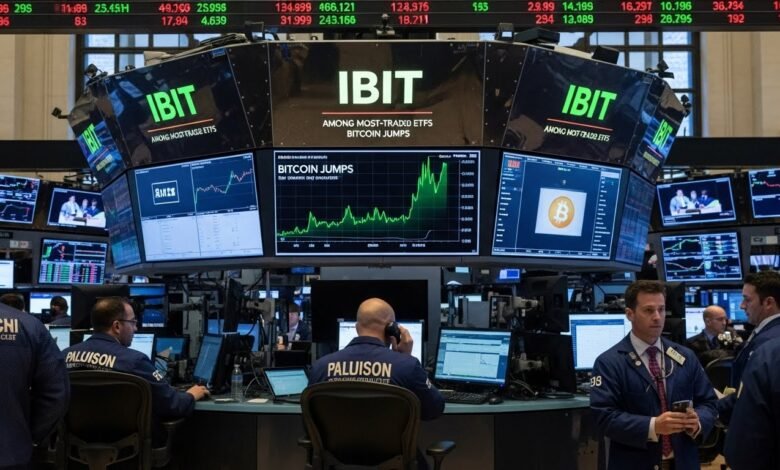
Bitcoin’s latest rebound has done more than lift the price of the world’s biggest cryptocurrency. It has also pushed BlackRock’s iShares Bitcoin Trust (IBIT) back into the spotlight as one of the most-traded ETFs in the U.S. market, even outpacing some long-established equity funds. At the same time, many Bitcoin mining stocks are struggling, creating a striking divergence between direct Bitcoin ETF exposure and traditional crypto-equity plays.
This split is important because it shows how investor preferences in the crypto ecosystem are evolving. For years, investors who wanted exposure to Bitcoin but could not or did not want to hold coins directly often turned to miners, exchanges, or proxy stocks. Now, with spot Bitcoin ETFs like IBIT offering simple, regulated access to BTC, money is flowing into these products even while crypto mining shares lag behind.
Bitcoin itself has staged a notable rebound, climbing from recent lows near 84,000 dollars to trade around the 92,000–93,000 dollar region, a gain of roughly 7 percent in just twenty-four hours at one point.This bounce has reignited trading activity across Bitcoin ETFs, with IBIT consistently recording tens of millions of shares traded daily and periodically smashing volume records.
In this in-depth guide, we will unpack why IBIT is among the most-traded ETFs, why Bitcoin mining stocks are sinking, and what this divergence means for traders and long-term investors trying to navigate an increasingly complex digital-asset landscape.
Understanding IBIT: The Flagship Spot Bitcoin ETF
What IBIT Actually Is
IBIT, short for iShares Bitcoin Trust, is BlackRock’s flagship spot Bitcoin ETF. Rather than using futures contracts, IBIT holds actual Bitcoin on behalf of investors and issues shares that represent fractional ownership of that BTC. This structure lets investors gain direct Bitcoin price exposure through a brokerage account, just as they would with an S&P 500 or gold ETF, without worrying about wallets, private keys, or exchanges.
For many investors, especially institutions and advisors, this is a game-changer. A Bitcoin exchange-traded fund plugs straight into existing infrastructure: retirement accounts, model portfolios, and institutional mandates that previously could not touch crypto. IBIT essentially wraps BTC in a familiar, regulated fund structure and trades on traditional stock exchanges during normal market hours.
Why IBIT Is Among the Most-Traded ETFs
Large trading volume is a signal that an ETF has become a key vehicle for investors. On several recent sessions, IBIT’s share turnover has reached extraordinary levels, including days with more than 70–80 million shares changing hands and record sessions where IBIT alone generated around 8 billion dollars in notional trading volume.
At times, this has made IBIT one of the most actively traded ETFs in the entire U.S. market, surpassing giants like Vanguard’s VOO that track the S&P 500. On a standout inflow day earlier this year, IBIT drew roughly 877 million dollars of new money, beating every other U.S. ETF on the board, including long-time liquidity leaders.
This kind of traffic tells us several things:
First, institutional demand for Bitcoin via ETFs is real. Major asset managers, hedge funds, and advisors increasingly prefer a spot Bitcoin ETF over buying BTC on a crypto exchange. Second, IBIT has rapidly become one of BlackRock’s most profitable funds, with fee revenue surpassing even some of its flagship index products as assets approach the 100-billion-dollar mark.
In other words, IBIT’s status among the most-traded ETFs is not a one-off fluke; it reflects a structural shift toward Bitcoin as a mainstream portfolio asset.
Bitcoin’s Latest Surge: The Macro and Market Backdrop
BTC’s Rebound From Recent Lows
The renewed trading frenzy in IBIT comes as Bitcoin price has rebounded from a sharp correction. After hitting all-time highs above 120,000–126,000 dollars earlier in the year, BTC slid more than 30 percent, bottoming around 80,000–84,000 dollars before staging a sharp bounce back near 92,000 dollars.
This recovery coincides with improved risk sentiment, short-covering, and opportunistic dip buying. Analysts note that the 84,000-dollar region roughly overlaps with the average cost basis of U.S. spot Bitcoin ETFs, a level that many traders now watch as a critical support zone.
At the same time, macro uncertainty remains high. Concerns about global growth, interest-rate changes, and liquidity have triggered bouts of risk-off behavior across tech stocks and digital assets. Periods of intense volatility have led to heavy liquidations in leveraged positions, magnifying both the downside moves and subsequent rebounds.
ETF Flows: From Record Inflows To Record Outflows
Bitcoin ETFs have been central to this boom-and-bust cycle. Earlier in the year, spot Bitcoin ETFs—led by IBIT—saw huge inflows that helped drive BTC to record highs. Over time, however, as the price faltered, sentiment turned. In November, U.S. spot Bitcoin ETFs collectively recorded about 3.79 billion dollars in net outflows, the largest monthly bleed since these products launched.
This mix of strong trading activity but volatile flows highlights how ETFs concentrate sentiment. When Bitcoin rallies, ETFs like IBIT often lead the charge as the easiest on-ramp. When Bitcoin sells off, those same ETFs become convenient exit ramps, leading to sharp swings in net flows while remaining among the most-traded funds on the market.
Why Bitcoin Mining Stocks Are Sinking While IBIT Shines
Miners No Longer Move One-for-One With Bitcoin
Historically, Bitcoin mining stocks tended to move in exaggerated fashion relative to BTC. When Bitcoin climbed, miners often soared; when BTC plunged, miners crashed even harder. That relationship still exists, but the market’s focus is shifting.
Recently, several publicly traded miners, including names like Iris Energy (IREN) and Cipher Mining (CIFR), have posted steep single-day losses and sustained drawdowns, even during periods when Bitcoin itself was rallying. Forecasts and technical outlooks for some miners remain cautious, with bearish sentiment readings and high volatility, signaling that the market expects more turbulence ahead.
Meanwhile, IBIT and other spot Bitcoin ETFs continue to capture flows and trading volume, becoming the preferred instrument for pure BTC exposure. The result is a widening performance gap: IBIT among the most-traded ETFs, while mining stocks sink or underperform both BTC and ETFs over key periods.
Cost Pressures, Halving, and Margin Squeeze
Another reason mining stocks underperform is that they are not just a play on Bitcoin’s price. They are also capital-intensive businesses dealing with:
When the Bitcoin halving cuts block rewards, miners need either a much higher BTC price or significantly more efficient operations to maintain profitability. If Bitcoin’s rebound is modest or choppy, and energy prices remain elevated, miners’ margins can get squeezed even as BTC trades at historically high levels.
Investors have become more sensitive to these fundamentals. They increasingly differentiate between pure Bitcoin price exposure via IBIT and operationally complex mining businesses that can suffer from cost overruns, dilution from secondary offerings, or balance-sheet stress—issues that an ETF like IBIT does not face in the same way.
Dilution, Debt, and Volatility Turn Off Some Investors
Some miners have added to their own problems by issuing new shares or taking on debt to fund expansion during the bull run. When sentiment turns, this can intensify downside moves; investors worry about dilution, debt servicing, and the risk of restructuring if the Bitcoin price spends too long below break-even levels for the company’s fleet.
By contrast, IBIT’s structure is simpler: the trust issues or redeems shares backed by Bitcoin holdings. Its risk profile is closely tied to the underlying BTC price and the integrity of its custodial arrangements, rather than to the capital structure of a single operating company. That simplicity is a big part of why investors flock to IBIT when they want clean Bitcoin ETF exposure without company-specific risk.
Rotation From Miners To Spot Bitcoin ETFs
The Appeal of Direct Bitcoin Exposure
One of the clearest trends in this cycle is the rotation from miners and proxy stocks into spot Bitcoin ETFs like IBIT. Investors who previously bought miners to gain BTC-linked upside now have a more direct, lower-friction option.
Regulated market access via standard brokerage accounts
Transparent Bitcoin holdings and net asset value (NAV)
Tight bid–ask spreads thanks to huge trading volume
No need to manage wallets, private keys, or crypto exchange risk
Unsurprisingly, the growth of IBIT and similar funds has been explosive. IBIT now ranks as BlackRock’s most profitable ETF by fee revenue and sits near the top of the global ETF universe by assets. For many portfolio managers, buying IBIT instead of a miner is a straightforward decision: it gives pure Bitcoin exposure, not a leveraged, operationally messy bet.
How Big Asset Managers Are Accelerating the Shift
The shift becomes even more pronounced as traditional giants like Vanguard start allowing clients to trade crypto ETFs on their platforms. Although Vanguard has historically criticized Bitcoin and still has no immediate plans to launch its own crypto funds, it has begun letting customers buy third-party Bitcoin and crypto ETFs—including products like IBIT—through its brokerage.
This policy change opens the door for millions of conservative or previously excluded investors to allocate to Bitcoin ETFs directly. As these flows grow, they are more likely to favor large, liquid funds such as IBIT than small or mid-cap miners. The result is a reinforcing cycle: more access to ETFs, more volume in IBIT, and more pressure on Bitcoin mining stocks that have to compete for attention.
What IBIT’s Dominance Means For Crypto Markets
IBIT As a Barometer of Institutional Sentiment
Because IBIT is among the most-traded ETFs, its flows and volume act as a real-time sentiment gauge. Heavy net inflows typically signal institutional accumulation and broader comfort with Bitcoin as a macro asset. Net outflows, especially during sharp drawdowns, reveal risk-off positioning and de-risking among professional money managers.
For traders, watching IBIT’s daily volume and flow data can be as important as tracking on-chain metrics or derivatives funding rates. When IBIT’s liquidity surges on a day of strong price action, it often indicates that large players are using the ETF as their primary vehicle to express a view on Bitcoin.
Feedback Loops Between Spot, ETFs, and Equities
As spot Bitcoin ETFs become central to price discovery, feedback loops emerge:
When BTC rallies, ETF demand rises, which can require more BTC purchases by the funds’ authorized participants.
Higher demand from ETFs can tighten supply on exchanges, potentially amplifying upside moves.
Conversely, heavy ETF redemptions can accelerate selling pressure if they require liquidation of BTC holdings, feeding downside volatility.
Meanwhile, Bitcoin mining stocks sit at the edge of this loop. Their revenue depends on BTC price and network conditions, but their stock performance increasingly reflects investor attitudes toward operational risk and capital structure rather than pure Bitcoin direction. This explains why we can see IBIT trading near record volumes on days when mining stocks are sinking, even though all are tied to the same underlying asset.
Key Risks and Considerations For Investors
Risks of Using IBIT and Other Spot Bitcoin ETFs
Although IBIT offers a clean and convenient way to gain Bitcoin exposure, it is not risk-free. Investors still face the underlying Bitcoin price volatility, which can be extreme. As recent moves have shown, BTC can fall more than 30 percent from its highs in a short period, and ETF investors feel that full impact in their share prices.
However, compared with dealing directly with exchanges and self-custody, many investors see an ETF like IBIT as a lower-friction, more regulated option, especially in retirement or institutional accounts.
Risks of Sticking With Bitcoin Mining Stocks
On the other side, Bitcoin mining stocks amplify both Bitcoin’s volatility and corporate-level risks. Investors must worry about:
When the market mood sours, miners can fall much faster than Bitcoin itself. Yet they can also rally dramatically if BTC stages a sustained bull trend and if the company has efficient operations, strong financing, and competitive energy costs. For that reason, some investors still treat miners as a leveraged bet on Bitcoin alongside a core position in IBIT or other spot Bitcoin ETFs.
What This Divergence Signals About Bitcoin’s Next Phase
The fact that IBIT is among the most-traded ETFs while mining stocks sink says a lot about where the crypto market is headed. It suggests that Bitcoin has moved deeper into the mainstream, where investors favor clean, index-style exposure over messy, idiosyncratic corporate bets.
This does not mean miners are irrelevant, but it does mean that the first stop for many newcomers or institutions is now a spot Bitcoin ETF, not a mining stock. As ETF infrastructure matures and giants like Vanguard open their doors to crypto funds, this trend is likely to strengthen, making products like IBIT central to how global capital interacts with Bitcoin.
In the long run, this could stabilize Bitcoin’s investor base by anchoring a larger portion of holdings inside regulated funds, even if it introduces new vulnerabilities linked to ETF flows and traditional market sentiment. For now, the key takeaway is clear: Bitcoin’s surge is increasingly expressed via IBIT and other spot ETFs, while mining stocks absorb the growing pains of an industry still adapting to halving cycles, rising costs, and institutional scrutiny.
Conclusion
IBIT’s rise among the most-traded ETFs underscores how dramatically the landscape for Bitcoin investing has changed. With BlackRock’s spot Bitcoin ETF offering a simple, liquid, and regulated gateway to BTC, investors have flocked to IBIT as their primary vehicle for crypto exposure, driving record trading volumes and cementing its role at the heart of the digital-asset ecosystem.
At the same time, Bitcoin mining stocks are sinking or lagging behind, weighed down by cost pressures, halving-driven margin compression, dilution, and the simple reality that investors no longer need to buy miners to get Bitcoin exposure. The divergence between IBIT’s strength and miners’ weakness is therefore less a short-term anomaly and more a reflection of a deeper structural shift.
For investors, the message is nuanced. IBIT and other spot Bitcoin ETFs are powerful tools for direct BTC exposure but come with the full force of Bitcoin’s volatility. Mining stocks, meanwhile, add layers of operational and financial risk that can either turbo-charge returns or magnify losses, depending on timing and execution.
As the market evolves, keeping an eye on IBIT’s trading volume, ETF flows, and Bitcoin’s price action, while understanding the fundamentals of miners, will be crucial. The story of IBIT among the most-traded ETFs as Bitcoin surges and mining stocks sink is, ultimately, the story of Bitcoin’s ongoing transition from speculative niche asset to a core component of modern capital markets.
FAQs
Q. Why is IBIT among the most-traded ETFs right now?
IBIT has become one of the most-traded ETFs because it offers direct spot Bitcoin exposure in a familiar ETF wrapper. As Bitcoin rebounds from recent lows and volatility increases, traders and institutions prefer a liquid, regulated vehicle to express their view on BTC.
Q. How does IBIT differ from Bitcoin mining stocks?
IBIT holds actual Bitcoin on behalf of investors, so its price mainly tracks the Bitcoin spot price. In contrast, Bitcoin mining stocks are operating companies with revenues, costs, debt, and management decisions layered on top of BTC exposure.
Q. Why are Bitcoin mining stocks sinking while Bitcoin and IBIT rebound?
Mining stocks are sinking for several reasons. The recent halving and high energy costs have squeezed miners’ profit margins, and some companies have raised capital through share issuance, increasing dilution fears.
Q. Is IBIT safer than holding Bitcoin directly on a crypto exchange?
“Safer” depends on what kind of risk you care about. Holding IBIT in a brokerage account reduces some operational risks associated with crypto exchanges, such as hack risk, withdrawal freezes, or poor internal controls. The ETF is regulated, audited, and uses institutional-grade custodians.
Q. Should I choose IBIT or Bitcoin mining stocks for long-term exposure?
For long-term exposure strictly to Bitcoin’s price, many investors prefer IBIT or similar spot Bitcoin ETFs because they track BTC more directly and avoid company-specific risks.