
Bitcoin Drops Below 2025 Opening Price as Markets Bleed
Bitcoin drops below $95K as AI stocks tumble and ETF outflows grow, sparking fear across the crypto market. Is this the start of a deeper crash?

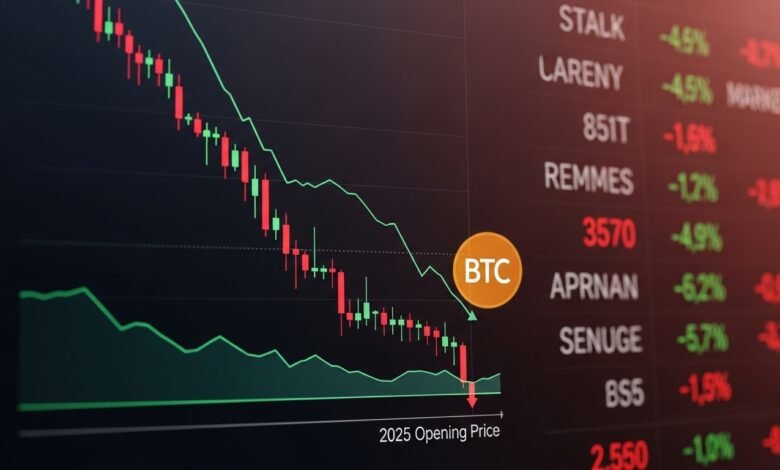
Opening Price as Markets Bleed. The latest Bitcoin news has jolted investors: after touching six-figure prices earlier this year, Bitcoin has now slid toward the mid-$90,000 range and briefly dipped below $95K. This drop hasn’t happened in isolation. It comes amid a sharp AI market crash, growing fears of an AI valuation bubble, and a wave of Bitcoin ETF outflows that signal investors are shifting to a risk-off stance.
Global equity markets have been under pressure as leading tech and AI names sell off hard, dragging major indices down and eroding risk appetite across the board. Analysts have warned that stretched valuations in AI stocks could trigger a deeper correction, and the recent global sell-off shows those fears are starting to materialize Cryptocurrencies, which tend to behave like high-beta tech, are taking a hit as well, with Bitcoin’s slide below $95K becoming a symbol of this broader shift in sentiment.
At the same time, Bitcoin ETF outflows in 2025 have raised questions about whether institutions are lockig in profits or losing confidence in the current cycle. Several spot Bitcoin ETFs have seen heavy redemptions, with hundreds of millions of dollars leaving in single sessions and record outflows reported earlier in the year That combination—AI tech weakness plus ETF redemptions—is putting pressure on the crypto market, wiping out trillions in value across digital assets in just a few weeks.
From AI Euphoria to Risk-Off Panic

For most of 2025, the dominant story in markets was the explosive rise of AI-related stocks and the parallel march of Bitcoin into six-figure territory. Major AI leaders and cloud giants powered the tech indices to new highs, while early spot Bitcoin ETFs helped funnel institutional capital into digital assets.Opening Price as Markets Bleed.
However, in recent weeks, that optimism has flipped into fear. Global stock markets have endured one of their sharpest pullbacks of the year, with the tech-heavy Nasdaq taking the biggest hit as investors start to question whether AI valuations have run too far, too fast. Senior banking executives and legendary investors have issued repeated warnings about a potential AI bubble, suggesting that leading AI names could see drawdowns of 20–40% if expectations reset.
When markets move into a risk-off mode, the first assets to be sold are typically those perceived as speculative: high-growth tech, AI stocks, and cryptocurrencies. As funds rotate into cash, short-duration bonds, or defensive sectors, Bitcoin can experience outsized moves—even if nothing has changed in its core fundamentals or long-term adoption story.Opening Price as Markets Bleed.
In this context, Bitcoin’s slide below $95K is less about a single headline and more about a broad, synchronized deleveraging across risk assets.
How the AI Market Crash Spilled Over into Crypto
Correlation Between Tech and Bitcoin
Over the past few years, Bitcoin has increasingly traded like a high-beta tech asset. During risk-on phases, it tends to outperform; during risk-off phases, it often underperforms as leverage unwinds. With global indices sliding on AI concerns and profit-taking, that correlation is once again on display
As AI leaders and big-cap tech names retreat, large multi-asset funds frequently rebalance their portfolios. That means trimming exposure not just to equities, but also to crypto holdings, particularly when Bitcoin has delivered outsized gains earlier in the cycle. The resulting selling pressure can push BTC through psychological support levels—like $100K and now $95K—triggering liquidations and forced unwinds across the crypto derivatives market.Opening Price as Markets Bleed.
Fear, Leverage, and Liquidations
The recent move in Bitcoin has been accelerated by cascading liquidations on futures platforms. When spot prices break key levels, heavily leveraged traders are forced to close out their positions, adding more sell orders into an already fragile order book. This is especially true when funding rates, open interest, and long positioning have been elevated after a prolonged bull run.
As Bitcoin slipped toward $95K, several derivatives trackers reported spikes in long liquidations, aligning with an extreme fear reading on crypto sentiment gauges.In other words, as AI stocks crashed and ETF flows turned negative, traders in both markets were essentially hit at the same time—turning a correction into something closer to a mini-capitulation event.
Bitcoin ETF Outflows: Profit-Taking or Red Flag?

What ETF Flows Are Telling Us
One of the most closely watched metrics in recent Bitcoin news has been ETF flows. The launch of spot Bitcoin ETFs brought in substantial institutional demand, helping push BTC to new all-time highs earlier this year. But as prices began to wobble, those same products started to see redemptions.
In early 2025, major spot Bitcoin ETFs logged record one-day outflows, with some funds losing more than $400 million in assets in a single session. More recently, the trend of Bitcoin ETF outflows has persisted, signaling that a portion of institutional capital is taking profits or temporarily stepping back from the market amid macro uncertainty.
These outflows matter because they represent large, transparent selling pressure. When ETF issuers redeem shares, they often have to sell spot Bitcoin to meet redemptions. That can amplify price declines precisely when retail sentiment is most fragile.
Why Bitcoin Dropped Below $95K: Key Drivers
1. Macro Jitters and Rate Expectations
Macroeconomic uncertainty is one of the biggest drivers behind the current sell-off. Investors are weighing mixed signals about inflation, growth, and the timing of potential rate cuts. When expectations for easy monetary policy are pushed further out, risk assets—from AI stocks to Bitcoin—face valuation pressure.
Recent reports have highlighted renewed concerns about labor market softness, government shutdown risk, and slower global growth, all of which feed into a more cautious risk-off environment. In that climate, Bitcoin’s reputation as digital gold competes with its behavior as a high-volatility risk asset, and lately the latter has dominated.
2. AI Market Crash and Bubble Fears
Prominent market commentators and bank CEOs have drawn comparisons between today’s AI enthusiasm and the dot-com bubble, warning of potential 15–20% corrections—or worse—if earnings fail to justify lofty valuations. When those warnings gained traction, global indices swooned, with the tech sector hit hardest. The result has been a classic AI market crash narrative: overbought, over-loved names finally undergoing a sharp repricing.
Since sentiment is contagious, the narrative of an AI bubble bursting spills directly into crypto. Bitcoin, long associated with speculative excess and crypto market mania, inevitably suffers when investors decide they’re done with “anything risky” for now.
3. Sentiment Shock and Extreme Fear
Crypto sentiment indicators currently flash extreme fear, reflecting a fast shift from euphor ia to panic as Bitcoin’s price retreated from six-figure territory to below $95K in a matter of weeks.Altcoins have seen even larger drawdowns, with many DeFi and Web3 names falling significantly more than Bitcoin.
History shows that such extreme readings don’t last forever—but they can fuel sharp downside moves before a bottom is found.
Short-Term Outlook: Volatility, Whipsaws, and Key Levels
Support and Resistance Zones to Watch
From a market-structure perspective, the $100K region has now turned from psychological support into resistance. Below that, traders are watching the mid-$90K area as a crucial battleground. Some on-chain and technical analyses still point to longer-term uptrends being intact as long as Bitcoin holds above prior cycle highs, but that’s cold comfort for anyone who bought near the top.
If selling pressure persists—for example, if AI stocks continue falling and Bitcoin ETF outflows accelerate—Bitcoin could probe deeper support zones. At the same time, any positive surprise, such as softer inflation data, constructive central bank messaging, or an AI earnings beat, could spark a sharp short squeeze as crowded shorts rush to cover.
What Traders Are Doing Now
In the near term, market participants are adopting very different strategies:
Some short-term traders are stepping aside completely, waiting for volatility to cool before re-entering. Others aim to trade the range, buying dips below $95K and selling into bounces, while closely monitoring ETF flows, funding rates, and derivatives positioning.
Across social media and trading desks, the tone of Bitcoin news has shifted from “when will we hit $150K?” to “have we seen the top?” Yet history suggests that Bitcoin’s biggest bull markets often include multiple corrections of 20–40% along the way. In that sense, the current sell-off—while painful—remains consistent with prior cycles.
Long-Term Perspective: Has the Bull Market Broken?
Adoption, Halving Cycles, and Institutional Interest
Ongoing institutional adoption through spot Bitcoin ETFs and corporate treasuries.
Periodic halving events that reduce supply issuance and have historically preceded multi-year uptrends.
Growing awareness of Bitcoin as a potential hedge against monetary debasement, even if its short-term correlation to risk assets remains high.
Even amid the current drawdown, some large players continue to accumulate. Recent filings show corporations and funds adding thousands of BTC during dips, indicating that not everyone sees this move below $95K as a reason to abandon ship.
Lessons from Previous Crashes
Every cycle brings a new narrative: ICOs, DeFi, NFTs, AI-linked tokens. But the pattern of boom, correction, consolidation, and renewed advance has repeated numerous times over Bitcoin’s history. In prior cycles, major corrections often coincided with macro jitters, regulatory headlines, or the unwinding of leverage—yet long-term holders who managed risk and stayed patient were often rewarded.
That doesn’t mean past performance guarantees future results. It does, however, suggest that short-term crashes driven by AI market fears and ETF flows are only part of the story, not the whole book.
Risk Management in a Hyper-Volatile Market
Avoiding Emotional Decisions
One of the biggest dangers in periods like this is emotional decision-making. When Bitcoin news headlines scream “crash,” “bubble,” and “capitulation,” it’s easy to panic sell near the lows or FOMO back in during a short-lived relief rally.
Maintaining a clear, pre-defined plan—whether that involves position sizing, stop-loss levels, or dollar-cost averaging—can help reduce the risk of making impulsive moves based on a single day’s price action.
Diversification and Time Horizon
Investors who treat Bitcoin as one component of a diversified portfolio tend to weather volatility better than those who go all-in. Spreading risk across asset classes (equities, bonds, commodities, and digital assets) can soften the impact of a crypto market crash or an AI stock meltdown.
Nothing in this article is financial advice; it’s essential to do your own research and, where appropriate, consult a licensed financial professional. Opening Price as Markets Bleed.
Could the AI Crash Ultimately Benefit Bitcoin?
Ironically, a severe AI bubble unwind could, over a longer horizon, strengthen Bitcoin’s narrative. If investors come to see certain high-flying AI names as overhyped and over-dependent on cheap capital, they may look more favorably on scarce, non-dilutive assets with transparent monetary policies.
In that sense, today’s AI-driven turmoil might eventually push more investors toward assets like Bitcoin, which has a known supply cap and a track record of surviving multiple cycles of euphoria and despair.
Conclusion
The headline Bitcoin news—that BTC has slipped below $95K amid an AI market crash and heavy ETF outflows—captures only one chapter in a much longer story. Short-term sentiment is undeniably bearish: global markets are under pressure, AI valuations are being questioned, and institutional money is taking chips off the table.
Yet the core pillars of the Bitcoin ecosystem—its fixed supply, expanding institutional rails, and growing role in the broader digital asset economy—remain intact. Whether this correction proves to be a temporary shake-out or the start of a deeper bear phase will depend on how macro conditions, AI earnings, and ETF flows evolve over the coming months.