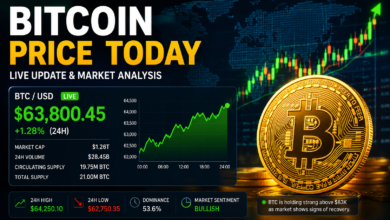
Bitcoin Recovers Above $67,000 as Markets Digest Khamenei’s Death
Bitcoin recovers above $67,000 following the confirmed death of Ali Khamenei. Explore how geopolitical shifts and oil price surges impact the crypto market.


The global financial landscape underwent a seismic shift over the weekend as news emerged of the death of Iran’s Supreme Leader, Ayatollah Ali Khamenei. In a world where digital assets often serve as a real-time barometer for geopolitical stability, the cryptocurrency market reacted with characteristic intensity. Initially, the news triggered a sharp sell-off, sending the premier digital asset tumbling toward the $63,000 support level. However, as Monday, March 2, 2026, begins, Bitcoin recovers above $67,000 as investors and institutions move past the initial shock. This resilience highlights a maturing market that is increasingly viewing Bitcoin not just as a speculative vehicle, but as a potential hedge against extreme macroeconomic and political uncertainty.
The recovery comes at a time when traditional markets are reeling from the implications of the leadership vacuum in Tehran. Traders are currently navigating a complex web of high-stakes diplomacy, military maneuvers, and inflationary fears. As the dust settles on this historic event, the ability of Bitcoin to reclaim key psychological levels provides a fascinating glimpse into the current crypto market sentiment and its relationship with global conflict.
How Bitcoin Recovers Above $67,000 Amid Geopolitical Chaos
The price action of the last 48 hours has been a masterclass in market psychology. When reports first surfaced of joint military operations in Iran, the immediate reflex of the market was to “de-risk.” This led to a cascade of liquidations totaling nearly $500 million across various exchanges. Yet, the narrative shifted almost as soon as the death of Khamenei was confirmed. The realization that the event might lead to a long-term restructuring of Middle Eastern power dynamics—rather than an immediate global conflagration—allowed buyers to step back in. Consequently, Bitcoin recovers above $67,000, effectively wiping out the “panic dip” that had characterized the Saturday trading session.
Technical analysts are keeping a close eye on this rebound. The $67,000 mark is more than just a number; it represents a historical level of market consolidation where bulls and bears have frequently battled for control. By reclaiming this territory, Bitcoin is signaling that the underlying blockchain technology and its decentralized nature remain attractive to those looking for assets outside the reach of traditional state-controlled financial systems. The current BTC price stability around this level is being viewed as a sign of strength, especially as Asian equity markets open with significant losses.
The Impact of the Iran Crisis on Digital Assets
The death of a major world leader always brings a period of “price discovery” for global assets. In this instance, the impact on Bitcoin was amplified by the simultaneous surge in energy prices. With Brent crude spiking past $80 per barrel, the specter of renewed inflation has returned to the forefront of investor minds. Historically, Bitcoin has performed well in high-inflation environments, which may explain why Bitcoin recovers above $67,000 even as other risk assets struggle. Investors are increasingly looking at the BTC fixed supply of 21 million as a necessary counterweight to the potential devaluation of fiat currencies in a war-time economy.
Furthermore, the role of prediction markets like PolyMarket and Kalshi cannot be ignored. These platforms saw tens of millions of dollars in volume as participants bet on the outcome of the Iranian strikes. The transparency of these on-chain bets often provides a leading indicator for price movements.
Institutional Sentiment and ETF Inflows
One of the most significant differences between this geopolitical shock and those of previous cycles is the presence of U.S.-based Bitcoin ETFs. Large institutional players, including BlackRock and Fidelity, now hold a substantial portion of the circulating supply. Early data suggests that these institutional holders did not panic-sell during the weekend volatility. Instead, the stability of ETF-linked wallets has provided a floor for the market. This institutional “diamond hands” approach is a primary reason why Bitcoin recovers above $67,000 so efficiently compared to the chaotic crashes of the 2018 or 2021 eras.
Market observers are now waiting for the Monday opening of the New York Stock Exchange to see if the spot Bitcoin ETF flows remain positive. If Wall Street chooses to view the Iranian situation as a catalyst for a broader shift toward “hard assets,” we could see an even more aggressive move toward the $70,000 resistance zone. The current Bitcoin market capitalization of approximately $1.3 trillion reflects a growing consensus that digital assets are a permanent fixture of the global financial architecture, capable of weathering even the most severe political storms.
Technical Analysis: Resistance and Support Levels
As Bitcoin recovers above $67,000, the technical chart shows several interesting developments. The asset is currently trading above its 50-day Exponential Moving Average (EMA), which is a classic bullish signal. However, the Relative Strength Index (RSI) remains in neutral territory, suggesting that while the immediate panic has subsided, the market is not yet “overbought.” This leaves room for further upside if the geopolitical situation remains stable. The next major hurdle is the $68,500 mark, which has served as a stubborn ceiling throughout early 2026.
On the downside, the $63,000 level has established itself as a formidable support zone. The fact that the market was able to bounce so sharply from these lows is a testament to the supply exhaustion among short-term holders. This shift in ownership is a fundamental reason why Bitcoin recovers above $67,000 and maintains its footing despite the ongoing uncertainty in the Middle East.
Comparison with Gold and Oil Markets
It is instructive to compare the recovery of Bitcoin with the performance of traditional safe havens. Gold has tested new highs near $5,400 per ounce, and oil is seeing its most dramatic gains in over a decade. Usually, Bitcoin is correlated with tech stocks, which are currently down. However, in this specific instance, we are seeing a “de-correlation” event. As Bitcoin recovers above $67,000, it is behaving more like a commodity than a high-beta stock. This transition is something that crypto analysts have predicted for years, and the current crisis may be the definitive proof of Bitcoin’s status as “Digital Gold.”
The closure of the Strait of Hormuz has direct implications for global trade and the US Dollar’s strength. As the world watches to see if the conflict will expand, the decentralization of Bitcoin becomes its most valuable feature. Future Outlook for the Crypto Market in 2026
Looking ahead, the remainder of March 2026 is likely to be defined by how the Iranian government restructures itself. Any sign of a pragmatic or de-escalatory successor to Khamenei would likely fuel a massive rally in risk assets. Conversely, a hardline response could lead to further volatility. Regardless of the outcome, the fact that Bitcoin recovers above $67,000 today suggests that the market has already “priced in” a significant amount of the bad news. This resilience often precedes a longer-term bull run as the “wall of worry” is climbed.
Investors should also remain aware of upcoming regulatory milestones. When combined with the current geopolitical backdrop, this regulatory progress could provide the fuel needed for Bitcoin to eventually challenge its all-time highs. For now, the focus remains on the $67,000 level. As long as Bitcoin recovers above $67,000 and holds that ground, the path of least resistance remains upward.
Strategic Considerations for Investors
Diversification remains essential. While Bitcoin is leading the charge, other assets like Ethereum and Solana are also showing signs of life. However, Bitcoin’s dominance remains high, as it is the primary choice for investors seeking a safe harbor within the digital asset space. Monitoring the Bitcoin dominance index will be crucial in the coming weeks to see if capital starts to rotate back into “altcoins” or if it stays concentrated in the flagship currency as Bitcoin recovers above $67,000.
The events of the past few days have been nothing short of historic. The death of Ali Khamenei has sent shockwaves through the world’s political and financial systems, yet the response from the digital asset space has been remarkably robust. As Bitcoin recovers above $67,000, it sends a clear message to the world: decentralized finance is no longer a fringe experiment but a resilient pillar of the global economy. The ability to absorb a shock of this magnitude and reclaim vital price levels within 48 hours is a milestone for the entire industry.
As we move forward, the relationship between geopolitical conflict and digital asset pricing will only become more intertwined. Stay informed and watch the charts closely—if you want to stay ahead of the next big move, now is the time to analyze how Bitcoin recovers above $67,000 and what that means for your portfolio.
See more;How Long Until Bitcoin Recovers? Data Reveals Key Clues