
NFT Market Cap Drops $1.2B as Ether Rally Stalls
NFT market cap plunges $1.2B amid Ethereum's stalling rally. Pudgy Penguins overtake Bored Apes in historic shift. Latest NFT trends analyzed.

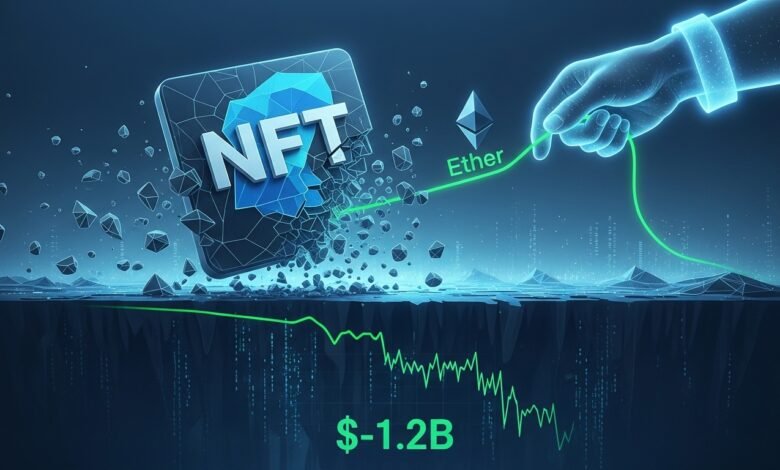
NFT market cap drops by $1.2 billion, coinciding with Ethereum’s stalling price momentum. This significant market correction has sent shockwaves through the Web3 community, particularly as Pudgy Penguins achieved what many thought impossible—surpassing the once-dominant Bored Ape Yacht Club in market capitalization. The correlation between Ethereum’s price action and non-fungible token valuations has never been more apparent, with collectors and investors scrambling to understand the implications of this seismic shift. As the NFT market cap drops continue to dominate headlines, industry analysts are questioning whether this represents a temporary correction or signals a fundamental restructuring of digital asset hierarchies within the blockchain ecosystem.
$1.2 Billion NFT Market Decline
The recent NFT market cap drops represent one of the most significant contractions the digital collectibles market has witnessed in recent months. This $1.2 billion evaporation in market value didn’t occur in isolation—it directly correlates with Ethereum’s price stagnation after what appeared to be a promising rally. When Ether’s upward momentum halted around key resistance levels, the ripple effects throughout the NFT ecosystem were immediate and severe.
Market data reveals that the decline wasn’t uniformly distributed across all projects. While some collections maintained relative stability, others experienced double-digit percentage drops in floor prices within 24-hour periods. The Ethereum NFT market has historically shown strong correlation with ETH price movements, and this latest downturn reinforces that relationship. Traders who had anticipated continued Ethereum strength found themselves holding depreciating digital assets as the broader cryptocurrency market entered a risk-off phase.
The timing of this market correction proves particularly significant given the increased institutional interest in digital collectibles over the past year. Several major brands had recently announced NFT initiatives, and venture capital firms had deployed substantial capital into NFT-focused startups. This NFT market cap drops scenario has forced many of these stakeholders to reconsider their short-term strategies while maintaining long-term conviction in the technology’s potential.
The Ethereum Connection: Why Ether’s Rally Matters for NFTs
Ethereum serves as the foundational infrastructure for the overwhelming majority of high-value NFT transactions, making its price performance an essential factor in NFT market trends. When Ether experiences robust price appreciation, several positive dynamics typically emerge for the digital collectibles market. Holders feel wealthier due to their ETH appreciation, creating a wealth effect that encourages discretionary spending on NFTs. Additionally, rising Ethereum prices often attract new participants to the ecosystem who then explore various applications, including non-fungible tokens.
The recent rally that subsequently stalled had pushed Ethereum toward psychologically important price thresholds. Many market participants had positioned themselves for a breakout above these levels, which would have likely catalyzed increased NFT trading volume as participants rotated profits into digital collectibles. However, when Ethereum encountered resistance and began consolidating, the anticipated capital rotation never materialized. Instead, some NFT holders began liquidating positions to either take profits or reduce risk exposure.
This interconnection between Ethereum price impact on NFTs creates both opportunities and vulnerabilities for the digital collectibles market. While strong ETH performance can lift all boats, as evidenced during previous bull runs, stagnation or decline in Ethereum’s value tends to disproportionately affect NFT valuations. The technical infrastructure requires ETH for gas fees, creating an additional layer of friction when the native token’s value becomes uncertain. Collectors become more cautious about executing transactions that require significant gas expenditures when they’re uncertain about the direction of their primary holding.
Pudgy Penguins’ Historic Ascension Over Bored Apes
In what represents perhaps the most striking development amid the broader market decline, Pudgy Penguins floor price dynamics propelled the collection past Bored Ape Yacht Club in total market capitalization. This milestone marks a significant shift in the hierarchy of blue-chip NFTs and challenges long-held assumptions about which projects would dominate the digital collectibles landscape long-term.
Pudgy Penguins has executed a remarkable turnaround strategy since new leadership acquired the project. The team implemented an aggressive merchandising approach, placing physical Pudgy Penguin toys in major retail chains including Walmart and Target. This real-world presence created tangible touchpoints for the brand beyond digital spaces, introducing the intellectual property to demographics that might never engage with blockchain technology directly. The strategy of bridging digital and physical realms has proven exceptionally effective in building brand recognition and value.
The Bored Ape Yacht Club decline relative to Pudgy Penguins doesn’t necessarily indicate fundamental problems with the Yuga Labs flagship collection. Rather, it reflects evolving market preferences and the maturation of the NFT space. Bored Apes dominated during an era when exclusivity and celebrity endorsements drove valuations. The current market appears to reward projects demonstrating practical utility, brand extension, and sustainable business models beyond initial minting revenue. Pudgy Penguins’ approach of creating recurring revenue streams through licensing and merchandise sales aligns more closely with traditional brand-building principles.
This changing of the guard has significant psychological implications for the broader digital collectibles market. It demonstrates that first-mover advantage and early dominance don’t guarantee perpetual leadership. Projects must continuously innovate, engage their communities, and demonstrate value creation beyond speculative trading. The Pudgy Penguins success story provides a blueprint for other collections seeking to build enduring brands rather than fleeting trends.
Analyzing Trading Volume Patterns During the Decline
NFT trading volume serves as a critical indicator of market health and participant engagement. During the recent $1.2 billion market cap contraction, trading volume patterns revealed important insights about investor sentiment and market structure. Contrary to what might be expected during a sharp decline, overall trading volume didn’t spike dramatically. This suggests the downturn resulted more from absence of buying pressure rather than panic selling.
Examining on-chain data shows that whale wallets—addresses holding significant NFT collections—largely maintained their positions rather than liquidating. The selling pressure appeared concentrated among smaller holders and more recent entrants to specific collections. This pattern indicates that experienced collectors with longer time horizons view current conditions as temporary volatility rather than fundamental deterioration. Their holding behavior provides a floor of support that prevents complete capitulation.
The distribution of NFT trading volume across different marketplaces also shifted during this period. OpenSea maintained its dominant position, but alternative platforms like Blur and Magic Eden captured increased market share as traders sought optimal liquidity and fee structures. This marketplace fragmentation creates challenges for accurate market analysis but ultimately benefits users through increased competition and innovation in trading infrastructure.
Secondary market dynamics revealed interesting divergences between collections with strong community engagement versus those driven primarily by speculation. Projects with active Discord servers, regular community events, and transparent roadmaps experienced relatively modest floor price declines. Collections lacking these community foundations saw more severe contractions, highlighting the importance of social cohesion in maintaining NFT valuations during adverse market conditions.
The Broader Implications for Digital Asset Markets
The NFT market cap drops of $1.2 billion must be contextualized within the larger digital asset ecosystem. Non-fungible tokens represent a relatively small segment of the overall cryptocurrency market capitalization, yet they serve as an important bellwether for retail interest and mainstream adoption of blockchain technology. When NFT markets struggle, it often signals broader risk aversion among cryptocurrency participants.
This correlation extends beyond mere coincidence. Many of the same factors that influence cryptocurrency valuations also impact NFT prices—regulatory uncertainty, macroeconomic conditions, technological developments, and shifting investor sentiment. The recent market contraction occurred against a backdrop of heightened regulatory scrutiny in multiple jurisdictions, with authorities examining how existing securities laws apply to digital assets including NFTs.
Institutional participants have been gradually increasing their NFT exposure through various mechanisms—direct purchases of high-value pieces, investments in NFT-focused funds, and acquisition of companies building NFT infrastructure. The current NFT market trends will likely influence the pace and scale of continued institutional adoption. Sophisticated investors typically seek evidence of market maturity, sustainable business models, and regulatory clarity before committing substantial capital. Market volatility and the displacement of previously dominant collections create uncertainty that may temporarily slow institutional participation.
However, the same market dynamics that concern short-term traders can create opportunities for long-term investors. Valuation compressions allow new entrants to acquire positions in established collections at more accessible price points. The restructuring of market leadership creates space for innovative projects to gain traction. Market corrections eliminate unsustainable projects and business models, ultimately strengthening the ecosystem’s foundation.
Pudgy Penguins’ Winning Strategy Decoded
Understanding how Pudgy Penguins achieved its remarkable position requires examining several strategic decisions that differentiated the project from competitors. The acquisition of the project by new leadership represented a critical turning point, bringing fresh vision and business expertise to a collection that had lost momentum under previous management.
The merchandising strategy deserves particular attention as it demonstrates how intellectual property developed in digital spaces can generate value in physical markets. By creating appealing character designs that translate well to toys and merchandise, Pudgy Penguins built a brand with intrinsic appeal beyond blockchain speculation. Parents purchasing toys for children at major retailers have no awareness of the NFT origins, yet each purchase reinforces brand recognition and creates potential future community members.
Social media presence and content creation formed another pillar of the Pudgy Penguins strategy. The team consistently produced engaging content across platforms, maintained active communication with the community, and leveraged trending formats to increase visibility. This sustained marketing effort kept the project in public consciousness even during periods of broader market weakness. The approach contrasts sharply with projects that generate intense interest at launch but fail to maintain engagement through ongoing content and community interaction.
Revenue diversification distinguishes successful digital collectibles market participants from those dependent solely on trading royalties. Pudgy Penguins developed multiple income streams—merchandise licensing, brand partnerships, and potential future media adaptations. This business model resilience provides stability regardless of secondary market trading conditions, allowing the team to continue building during market downturns when many competitors reduce operations.
What the Bored Ape Decline Reveals About Market Evolution
The relative positioning change between Bored Ape Yacht Club and Pudgy Penguins illuminates important truths about the maturing NFT ecosystem. Early NFT market success often resulted from scarcity, celebrity endorsements, and association with exclusive communities. Bored Apes exemplified this model—limited supply, high-profile owners, and exclusive membership benefits created significant perceived value.
However, as the market matured, participants began evaluating projects through more sophisticated frameworks. Sustainability of the business model, diversity of revenue streams, real-world brand building, and intellectual property development became increasingly important valuation factors. This evolution mirrors the transition from speculative to fundamental analysis that occurs in emerging asset classes as they mature.
Yuga Labs, the company behind Bored Ape Yacht Club, has certainly not been passive during this period. Their expansion into metaverse platforms through Otherside, acquisition of additional NFT collections, and development of new intellectual properties demonstrate ambitious growth strategies. However, the complexity and scale of these initiatives also create execution risks and potentially dilute focus from the core BAYC collection that initially drove their success.
The Bored Ape Yacht Club decline in relative market position doesn’t necessarily predict long-term trajectory. Market leadership changes occur regularly in competitive landscapes, and Yuga Labs possesses substantial resources and expertise to respond to evolving conditions. The current situation simply reflects that sustained dominance requires continuous innovation and value delivery rather than relying on historical brand strength.
Technical Factors Driving NFT Valuations
Beyond narrative and community dynamics, technical factors significantly influence NFT market cap drops and recoveries. Smart contract architecture, metadata storage solutions, provenance verification, and platform interoperability all contribute to a collection’s long-term value proposition. Collections built on robust technical foundations tend to weather market volatility more effectively than those with technical vulnerabilities or dependencies.
Gas fees on the Ethereum network create meaningful friction for NFT transactions, particularly during periods of network congestion. When base layer transaction costs spike, smaller transactions become economically unviable, effectively freezing certain market segments. Layer 2 scaling solutions and alternative blockchains have emerged partly to address these limitations, though the majority of high-value NFT activity remains concentrated on Ethereum mainnet due to network effects and security considerations.
Liquidity infrastructure has evolved considerably since the early days of NFT trading. Beyond simple marketplace listings, participants can now access NFT-backed lending protocols, fractional ownership platforms, and derivative instruments tied to collection floor prices. These financial innovations provide additional utility for NFT holders and create more efficient price discovery mechanisms. However, they also introduce complexity and potential systemic risks if leverage becomes excessive or counterparty failures occur.
The development of cross-chain bridges and multi-chain NFT standards represents another technical dimension influencing market dynamics. Collections that can move seamlessly between blockchain ecosystems potentially access broader liquidity and user bases. However, bridge security remains an ongoing concern following several high-profile exploits in the cryptocurrency space. Projects pursuing multi-chain strategies must carefully balance accessibility benefits against security risks.
Community Dynamics and Social Value in NFT Collections
The social dimension of NFT ownership often receives insufficient attention in market analysis focused primarily on price movements. For many participants, the community access and social identity provided by collection membership equals or exceeds the financial speculation motive. This social value component creates sticky demand that persists through market cycles, providing price support during downturns.
Discord servers, Twitter communities, and real-world meetups associated with major NFT collections function as modern social clubs. Members form relationships, share information, collaborate on projects, and support each other’s ventures. These network effects become self-reinforcing—as communities grow and strengthen, membership becomes increasingly valuable regardless of floor price movements. Projects that successfully cultivate strong communities enjoy structural advantages over those viewed purely as tradable assets.
The role of founders and leadership teams in maintaining community engagement cannot be overstated. Regular communication, transparent roadmap execution, and genuine interaction with community members build trust and loyalty. When holders believe the team is committed to long-term value creation and treats the community as partners rather than customers, they’re more likely to maintain positions through market volatility. This dynamic explains why some collections with modest artistic merit nonetheless maintain strong valuations based primarily on community strength.
Conversely, communities can deteriorate rapidly when leadership falters, promises go unfulfilled, or internal conflicts emerge. The anonymous or pseudonymous nature of many NFT project teams creates challenges for accountability and governance. Collections that transition successfully from founder-led to community-governed models often demonstrate greater resilience, though this transition involves complex coordination challenges.
Regulatory Landscape and Its Impact on NFT Markets
The evolving regulatory environment represents a significant uncertainty factor influencing NFT market trends and institutional participation. Regulators globally are examining how existing legal frameworks apply to non-fungible tokens, with particular attention to whether certain NFTs constitute securities subject to registration requirements and investor protection regulations.
Different jurisdictions have adopted varied approaches to NFT regulation. Some countries have issued specific guidance clarifying NFT treatment under existing law, while others maintain ambiguous positions that create uncertainty for market participants. This regulatory fragmentation complicates operations for projects with global communities and creates arbitrage opportunities as activity flows toward more favorable jurisdictions.
Intellectual property rights present another complex regulatory dimension for NFT collections. The relationship between NFT ownership and rights to underlying intellectual property varies significantly across projects. Some collections grant full commercial rights to holders, while others provide limited licensing or no IP rights at all. This variation creates confusion and potential legal disputes, particularly as collections begin generating meaningful revenue through merchandise and media adaptations.
Tax treatment of NFT transactions remains unclear in many jurisdictions, creating compliance challenges for active traders. Questions about whether NFT sales constitute capital gains, ordinary income, or collectibles subject to special tax rates lack definitive answers in most countries. This uncertainty discourages some institutional participants and creates potential future liabilities for individuals who may have incorrectly reported transactions.
The Intersection of NFTs and Broader Cryptocurrency Markets
NFT market cap drops rarely occur in complete isolation from broader cryptocurrency market movements. Bitcoin price action, Ethereum performance, and overall risk sentiment in digital asset markets all influence NFT valuations through multiple transmission mechanisms. Understanding these interconnections provides context for current market conditions and potential future trajectories.
When Bitcoin and major cryptocurrencies experience strong bull markets, capital rotation effects often benefit NFTs. Traders who generate profits from cryptocurrency price appreciation frequently diversify into digital collectibles, driving demand and prices higher. This pattern explains why major NFT bull runs have historically coincided with strong performance in underlying cryptocurrency markets.
Conversely, cryptocurrency bear markets or corrections typically precede or coincide with NFT market weakness. Risk appetite diminishes across the entire digital asset ecosystem, and participants become more conservative in their allocation decisions. The higher volatility and lower liquidity of NFT markets compared to major cryptocurrencies make them particularly vulnerable during risk-off periods.
The development of crypto-native financial infrastructure increasingly links NFTs with broader digital asset markets. Lending protocols that accept NFTs as collateral create direct connections between collection floor prices and cryptocurrency liquidity conditions. Derivative products tied to NFT indices allow traders to gain exposure or hedge positions without directly holding underlying assets. These financial innovations increase market efficiency but also create new contagion pathways during stress events.
Future Outlook: Recovery Scenarios and Market Predictions
Analyzing potential recovery paths from the current NFT market cap drops requires considering multiple scenarios based on different assumptions about underlying drivers. The most optimistic scenario involves renewed Ethereum strength coupled with successful project execution from major collections. If Ethereum breaks through current resistance levels and establishes sustained upward momentum, NFT markets would likely follow with improved sentiment and increased capital inflows.
A moderate recovery scenario assumes Ethereum consolidates at current levels while individual NFT projects differentiate based on execution and community strength. This environment would likely see continued leadership changes as the market rewards projects demonstrating genuine value creation. Collections focused on merchandising, entertainment, and real-world utility would potentially outperform those relying primarily on speculation and status signaling.
The pessimistic scenario involves further cryptocurrency market weakness, potentially triggered by adverse regulatory developments or macroeconomic deterioration. In this environment, NFT markets would likely experience additional contraction as risk appetite evaporates and participants prioritize capital preservation. However, even in this scenario, certain projects with strong fundamentals and committed communities would likely maintain core support.
Long-term structural trends appear favorable for the digital collectibles market despite short-term volatility. Increasing comfort with digital ownership among younger demographics, continued brand experimentation with NFT technology, and improving infrastructure for creation and trading all support eventual market expansion. The current correction may ultimately prove healthy by eliminating unsustainable projects and establishing more realistic valuation frameworks.
Lessons for NFT Investors and Collectors
The current market environment offers valuable lessons for both experienced participants and those considering entry into NFT markets. Perhaps most importantly, the Ethereum NFT market correlation demonstrates the importance of understanding how NFT valuations connect to broader cryptocurrency dynamics. Investors should monitor Ethereum price action, network metrics, and general cryptocurrency sentiment as leading indicators for potential NFT market movements.
Project fundamentals matter increasingly as the market matures. During the early NFT boom, virtually any collection could generate interest and trading volume based primarily on novelty and speculation. Current conditions reward projects with sustainable business models, strong communities, transparent leadership, and genuine utility beyond pure speculation. Due diligence on team backgrounds, roadmap feasibility, and economic sustainability should precede significant investment decisions.
Diversification across multiple collections and project types provides risk management benefits similar to traditional investment portfolios. Rather than concentrating holdings in a single collection or category, successful long-term participants typically maintain exposure across different segments—blue-chip collections, emerging projects, utility-focused NFTs, and art-focused pieces. This approach reduces dependence on any single project’s success and provides exposure to multiple potential growth vectors.
Community engagement enhances both the enjoyment and financial outcomes of NFT participation. Active involvement in collection Discord servers, attendance at virtual or real-world events, and contribution to project development create social value while building information advantages. Community members often receive advance notice of opportunities, gain insights into project direction, and develop relationships that enhance the overall experience beyond financial returns.
Conclusion
The NFT market cap drops of $1.2 billion amid Ethereum’s stalling rally represents a significant moment in the digital collectibles market evolution. Pudgy Penguins overtaking Bored Ape Yacht Club symbolizes broader shifts toward rewarding sustainable business models, real-world brand building, and community engagement over pure speculation and exclusivity. While short-term price movements capture headlines, the underlying trends point toward a maturing market with increasing sophistication among participants.
The interconnection between Ethereum NFT market performance and underlying blockchain asset prices will likely persist, creating both opportunities and risks for collectors and investors. Understanding these dynamics, conducting thorough project research, and maintaining realistic expectations about volatility positions participants for success regardless of short-term market fluctuations. Projects that build genuine value through compelling intellectual property, engaged communities, and diversified revenue streams will likely emerge stronger from current market conditions.
For those considering entering the NFT space or expanding existing positions, current market conditions may present attractive entry points for quality projects. The NFT market cap drops have created more accessible pricing for established collections while clearing away unsustainable projects that proliferated during peak speculation. As always, careful research, appropriate risk management, and long-term perspective serve as essential principles for navigating this dynamic and evolving digital asset class.
Stay informed about the latest NFT market trends by following reputable blockchain analytics platforms, engaging with project communities, and continuously educating yourself about both technical and market developments in this rapidly changing space.
See more;Bitcoin Price Drop: Double-Digit Decline Shakes Market