
Bitcoin Cash (BCH) Halving Explained: How Supply Cuts Could Shape Price
What the Next BCH Block Reward Cut Means for Miners, Supply, and Investors

The Bitcoin Cash halving is one of the most important scheduled events on the BCH network. Every four years, the protocol cuts the reward that miners earn for each new block in half. This change slows down the creation of new coins and reduces selling pressure from miners. Many traders watch this event closely because lower supply growth can influence price when demand stays strong. In this guide, you will learn how the halving works, what happened in past cycles, when the next one arrives, and which risks investors should weigh. You can also explore more market coverage on Cryptol7 to stay updated on altcoin trends.
What Is the Bitcoin Cash Halving?
The Bitcoin Cash halving is a built-in rule that cuts the block reward by 50 percent after every 210,000 blocks. Satoshi Nakamoto designed this rule for Bitcoin, and Bitcoin Cash kept it after the 2017 fork. The rule controls how fast new BCH enters the market. It also protects the 21 million coin supply cap that gives BCH its scarcity. Each halving reduces the number of new coins that miners receive, so the supply curve flattens over time. No central bank, company, or developer can change this schedule without network consensus. Key points to remember:
- The halving happens automatically at a fixed block height.
- The reward drops by exactly 50 percent each time.
- The total supply stays capped at 21 million BCH.
- The event repeats roughly every four years.
How the BCH Halving Works
Miners collect a block reward every time they add a new block to the chain. The network targets one block every ten minutes, which produces about 144 blocks per day. When the chain reaches the halving block, the protocol automatically lowers the reward. Miners receive less newly created BCH, but they still earn transaction fees on top. Because the reward shrinks, the daily flow of new coins into the market shrinks too. Nodes verify every block, so no miner can ignore or delay the change. The mechanism follows a simple pattern:
- Blocks 0 to 209,999 paid 50 BCH per block.
- Each later period of 210,000 blocks cut that amount in half.
- Fees from transactions help miners cover costs as rewards fall.
- The schedule continues until the reward reaches almost zero.
The Block Reward Schedule Explained
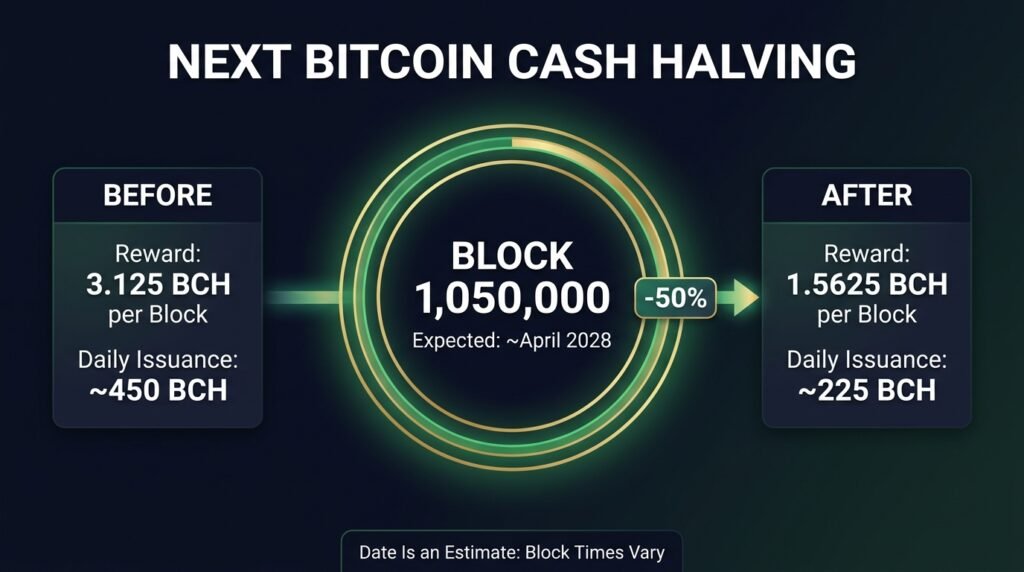
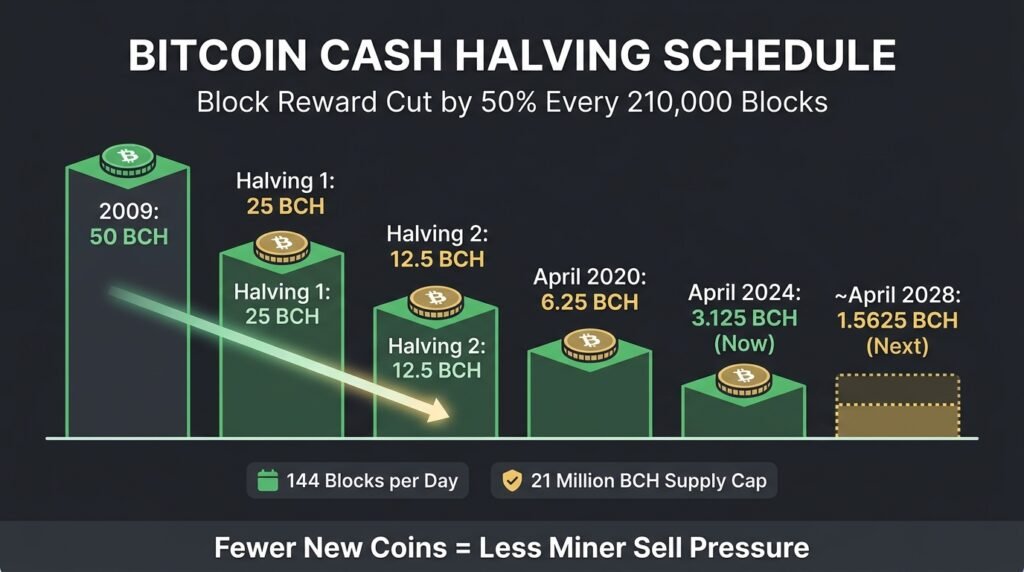
The reward started at 50 coins per block in 2009 and has fallen through four halvings since then. After the April 2024 halving, miners now earn 3.125 BCH per block. At 144 blocks per day, the network creates about 450 new BCH every day. That equals roughly 164,000 new coins per year, which is less than one percent of the circulating supply of around 20 million. After the next halving, the daily issuance will drop to about 225 coins. This steady decline makes BCH issuance more predictable than most fiat currencies. Investors can calculate future supply years in advance, and that transparency supports long-term planning.
Bitcoin Cash Halving History: 2020 and 2024
Bitcoin Cash has completed two halvings since its birth in August 2017. The first one took place in April 2020 and cut the reward from 12.5 to 6.25 BCH. The second arrived in April 2024 and cut it from 6.25 to 3.125 BCH. Both events happened shortly before major shifts in market sentiment. However, the price did not move in a straight line after either event. Broader market cycles, Bitcoin’s own performance, and global liquidity all shaped the results. Here is what the history shows:
- The 2020 halving came during the pandemic crash and a weak market.
- BCH price rallied strongly in the months after, during the 2021 bull market.
- The 2024 halving arrived near a Bitcoin ETF-driven rally.
- Price reactions varied, so no single pattern guarantees a repeat.
When Is the Next Bitcoin Cash Halving?
The next Bitcoin Cash halving will occur at block 1,050,000. Based on the ten-minute block time, analysts expect it around April 2028. The exact date can shift by days or weeks because block times fluctuate with mining speed. At that point, the reward will fall from 3.125 BCH to 1.5625 BCH per block. Daily issuance will then drop to roughly 225 coins. You can follow the countdown on public block explorers and on CoinMarketCap’s BCH page, which track block height and market data live. Remember these planning tips:
- Check the current block height regularly.
- Treat any date estimate as an approximation.
- Watch miner activity in the months before the event.
- Follow reliable news sources for updates.
How Supply Cuts Could Shape BCH Price
Supply cuts influence price through a simple economic principle. When demand holds steady and new supply shrinks, scarcity increases, and prices often rise. The halving reduces the flow of new BCH that miners can sell to cover their costs. Miners usually sell a large share of their rewards, so less issuance means less sell pressure. Traders also anticipate the event, and that anticipation can push prices up before the halving even happens. However, markets price in known events, so the effect may appear early or fade quickly. Several forces work together:
- Lower issuance reduces daily sell pressure from miners.
- Rising scarcity attracts long-term holders.
- Speculation often builds in the months before the event.
- Demand must stay strong, or supply cuts alone cannot lift price.
Impact on Miners and Network Security
The halving hits miners directly because their income from block rewards drops by half overnight. Miners with high electricity costs or old equipment may shut down their machines. Efficient miners with cheap power usually survive and gain a larger share of the reward pool. Lower hash rate can weaken network security in the short term, so the community watches this metric closely. Over time, rising prices or higher fees can restore mining profits. The network adjusts difficulty to keep block times stable, which helps absorb sudden changes.
Hash Rate Competition with Bitcoin
Bitcoin Cash shares the SHA-256 mining algorithm with Bitcoin, so miners can switch between the two chains. They always chase the most profitable option. When BTC pays better, miners move their hash power away from BCH, and security drops. When BCH pays better, miners return. The halving changes this balance because it alters BCH profitability. Miners compare block rewards, fees, and coin prices before they decide where to point their machines. Watching this flow gives investors a useful signal about network health.
Transaction Fees as a Long-Term Reward
Block rewards will keep shrinking, so fees must eventually fund network security. BCH supports larger blocks, which allows more transactions per block at low fees. High transaction volume can therefore replace part of the lost reward. If adoption grows, miners earn more from fees and rely less on new coins. If adoption stalls, miners may struggle after each halving. This fee model shapes the long-term health of the entire network.
Bitcoin Cash Halving vs Bitcoin Halving
Both chains follow the same 210,000-block halving rule, but their timelines differ. Bitcoin and Bitcoin Cash share early history, so they started with the same reward schedule. Their halving dates now drift apart because each chain mines blocks at a slightly different pace. BCH usually halves earlier than BTC when its blocks arrive faster. The two events also affect the market differently because Bitcoin has far greater demand and liquidity. Compare the main differences:
- BTC has a bigger market cap and wider institutional interest.
- BCH focuses on low fees and fast everyday payments.
- Both chains cap supply at 21 million coins.
- BCH halving news usually gets less attention but still moves traders.
Risks and Limits of the Halving Narrative
The halving story sounds simple, but real markets rarely follow simple stories. A supply cut does not guarantee a price rise because demand drives value just as much as scarcity. Weak adoption, regulatory pressure, or a falling crypto market can cancel any halving benefit. Miners who lose money may sell reserves, which adds temporary pressure. Hype can also create bubbles that collapse after the event passes. Investors should keep these risks in mind:
- Past performance does not predict future results.
- Bitcoin’s trend often leads altcoin prices.
- Low liquidity can magnify sharp swings.
- News and sentiment can overpower fundamentals.
How Investors Can Prepare for the Next Halving
Smart investors prepare long before the halving date. They study the supply schedule, track miner behavior, and set clear risk limits. Some investors buy gradually through dollar-cost averaging, which reduces the stress of timing the market. Others hold cash and wait for confirmation of a trend. Nobody can predict the exact outcome, so a written plan helps control emotions. Remember to size positions carefully and never invest money you cannot afford to lose. You can find guides, market updates, and analysis on Cryptol7 to support your research. Follow these steps:
- Research the BCH supply schedule and halving date.
- Set a budget and stick to it.
- Diversify across several assets instead of one coin.
- Review official data on the BCH project website.
Frequently Asked Questions
What happens to Bitcoin Cash during a halving?
The network cuts the block reward by 50 percent. Miners then receive fewer new BCH coins for each block they add, and the daily issuance of new supply drops by half.
How often does the Bitcoin Cash halving occur?
The halving occurs after every 210,000 blocks, which takes about four years. Block speed can move the exact date slightly earlier or later.
Will the Bitcoin Cash halving raise the price?
Nobody can promise a price rise. Lower supply growth can support price, but demand, Bitcoin’s trend, and market sentiment decide the final result.
How many BCH coins will ever exist?
The protocol caps the supply at 21 million BCH. The network will never create more than this amount.
Final Thoughts
The Bitcoin Cash halving remains a core feature of the BCH monetary policy. It reduces new supply, tests miner efficiency, and draws attention from traders around the world. History shows that price reactions vary, so investors should avoid blind predictions and focus on research. Track the block height, follow miner activity, and watch overall market demand before you make decisions. This article offers general information and does not give financial advice, so always do your own research. Visit Cryptol7 for more crypto news, price updates, and analysis.