From $82K to $109K: Why Wall Street Just Upgraded Bitcoin’s Q4 Outlook
How institutional money, ETF demand, and shifting macro forces reshape the Bitcoin Q4 outlook


The Bitcoin Q4 outlook just changed in a big way. Wall Street analysts raised their fourth-quarter expectations from around $82K to as high as $109K. This shift matters because large banks and asset managers rarely change their crypto views without strong evidence. Traders now ask a simple question: what did these analysts see that the market missed? The answer involves steady ETF inflows, shifting interest rate expectations, and a tighter supply of coins. This guide breaks down each driver in plain language. You will also learn the risks, so you can judge the new targets with a clear head. For more market coverage, visit Cryptol7 for daily crypto updates.
What Changed in the Bitcoin Q4 Outlook?
Analysts did not upgrade their forecasts overnight. They revised their models after several months of stronger data. Here is what shifted:
- Spot Bitcoin ETFs kept attracting new money week after week.
- Big institutions increased their Bitcoin allocations.
- Traders priced in a friendlier interest rate path.
- Exchange balances dropped, which signals fewer coins for sale.
Each of these signals pushes the Bitcoin Q4 outlook in the same direction. Analysts now treat $82K as a floor-style baseline instead of a ceiling. They also place $109K at the upper end of their base-case range. Remember that a target is a forecast, not a promise.
From $82K to $109K: Understanding the New Price Range
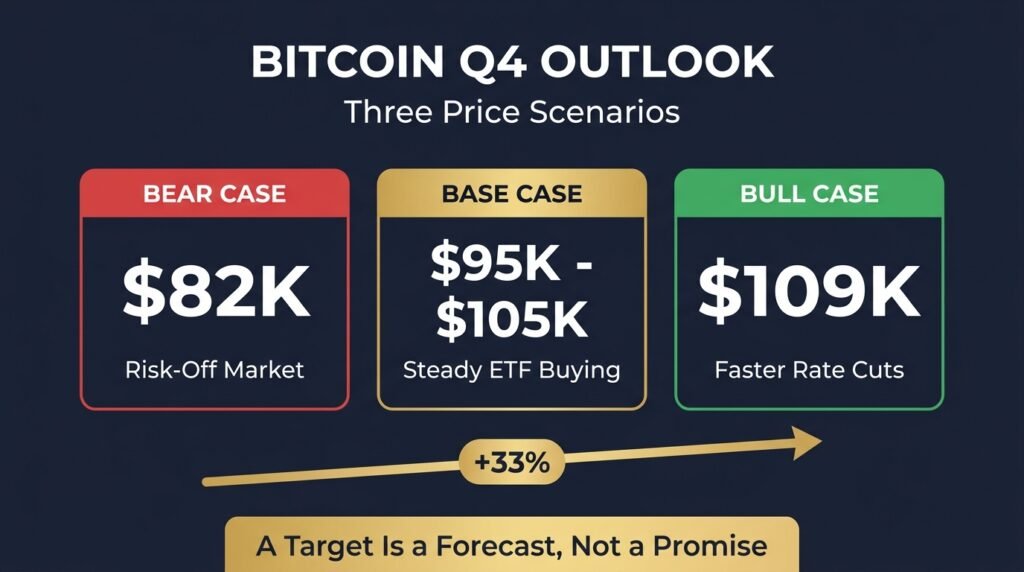
The jump from $82K to $109K equals roughly a 33% increase. That gap looks large, but Bitcoin has moved that far in a single quarter before. Analysts build these ranges from three scenarios.
The Base Case
The base case assumes steady ETF buying and stable macro conditions. Analysts expect Bitcoin to trade between $95K and $105K in this scenario. They view this path as the most likely one. Most bank research notes anchor on this middle range. It requires no surprise from the Federal Reserve or from regulators.
The Bull Case
The bull case pushes Bitcoin toward $109K and sometimes higher. It needs faster rate cuts and a surge in institutional demand. A weaker dollar would also help this scenario. Analysts give this path a meaningful probability but not a dominant one. Traders who chase this target should plan their exit points early.
The Bear Case
The bear case keeps Bitcoin near the old $82K level. A sudden risk-off move in global markets would trigger it. A sharp rise in bond yields could also do the damage. Analysts still list this scenario because Bitcoin remains a volatile asset. Smart investors respect the downside as much as the upside.
Why Wall Street Upgraded Its View: The Four Main Drivers Of Bitcoin
Four forces explain the upgrade. Each one deserves a closer look, because together they shape the entire Bitcoin Q4 outlook.
Driver 1: Steady Spot ETF Inflows
Spot Bitcoin ETFs changed how large investors buy the asset. Pension funds, advisors, and wealth managers now buy Bitcoin through familiar brokerage accounts. They no longer need to manage private keys or crypto exchanges. This convenience unlocks a huge pool of capital. Analysts track daily ETF flows as a core demand signal. Persistent inflows tell them that buyers keep absorbing new supply. That pattern supports higher prices through the end of the year.
Driver 2: Softer Interest Rate Expectations
Bitcoin tends to rise when investors expect lower interest rates. Lower rates reduce the appeal of cash and bonds. They also push investors toward assets with higher growth potential. Many analysts now expect the Federal Reserve to ease policy further. You can follow the latest policy statements on the Federal Reserve website. Traders react to every shift in tone. A dovish message often lifts Bitcoin within hours. This link between rates and crypto explains a big part of the upgrade.
Driver 3: A Tighter Coin Supply
Bitcoin has a fixed supply cap of 21 million coins. Miners now earn fewer new coins after the latest halving cycle. Long-term holders also keep more coins off exchanges. This combination shrinks the number of coins available for sale. When demand stays strong and supply tightens, prices usually climb. Analysts call this a supply squeeze. They expect the squeeze to matter most during Q4, when seasonal buying often picks up.
Driver 4: Growing Institutional Adoption
Corporations and funds continue to add Bitcoin to their balance sheets. Some companies hold it as a treasury reserve asset. Asset managers also launch new Bitcoin products at a steady pace. This trend gives Bitcoin more legitimacy each quarter. Regulators also provide clearer guidance than in earlier years. You can review regulatory updates on the SEC website. Clearer rules reduce fear among cautious investors. That confidence feeds directly into higher price targets.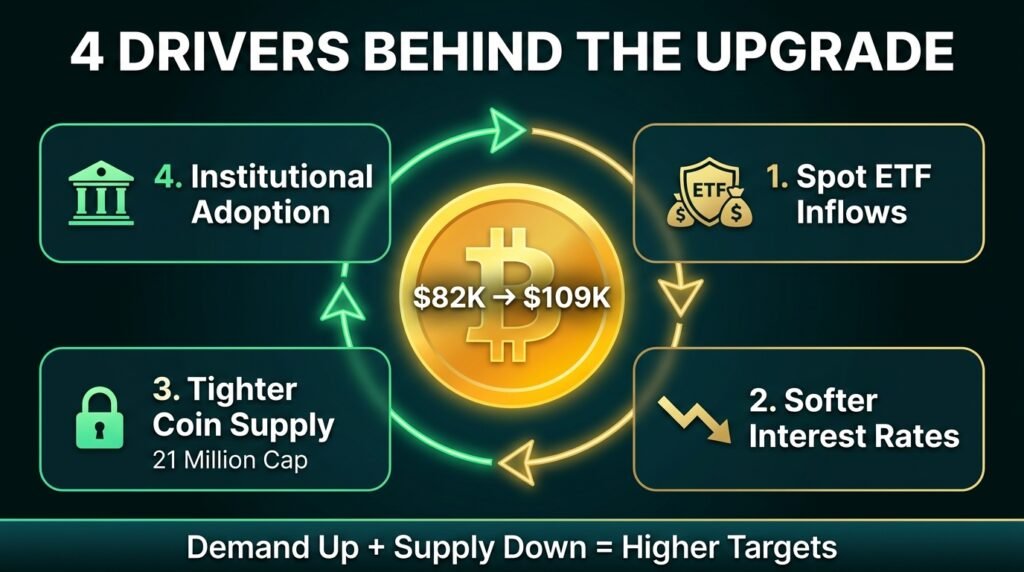
Key Numbers Behind the Bitcoin Q4 Outlook
Numbers help you compare scenarios quickly. Use this simple summary as a reference.
- Old baseline: around $82K
- New upper target: around $109K
- Implied upside: roughly 33% from the old baseline
- Main demand source: spot ETF and institutional buying
- Main supply factor: lower exchange balances and post-halving issuance
- Main macro driver: expected interest rate cuts
These figures show why analysts feel more confident today. Demand keeps growing while supply keeps shrinking. That imbalance forms the core of the bullish argument. Always check live prices before you act, because the market moves fast.
Risks That Could Derail the Bitcoin Q4 Outlook
Bullish forecasts attract attention, but risks deserve equal space. Several threats could break the upgrade thesis.
- Macro shocks: A surprise inflation report could delay rate cuts and hurt risk assets.
- ETF outflows: If investors pull money from ETFs, demand could weaken quickly.
- Regulatory surprises: A tough new rule could scare institutions away.
- Leverage liquidations: Overleveraged traders can trigger sharp, sudden drops.
- Geopolitical events: Global conflicts often push investors toward cash.
Bitcoin has dropped 20% or more in a few days many times before. Analysts know this history well. They still raise targets, but they also warn investors to size their positions carefully. No forecast removes this volatility.
How Investors Can Approach the Upgraded Forecast
A forecast helps most when you pair it with a plan. Follow these practical steps.
- Set your risk limit first. Decide how much loss you can accept before you buy.
- Use dollar-cost averaging. Buy in smaller, regular amounts instead of one large entry.
- Watch ETF flow data. Daily flows give you an early read on institutional demand.
- Track the Fed calendar. Rate decisions often move Bitcoin sharply.
- Take profits in stages. Selling part of your position at each target protects your gains.
- Keep learning. Read analysis on Cryptol7 to stay current on market shifts.
Treat this section as education, not financial advice. Every investor has different goals and a different risk tolerance. Speak with a licensed advisor before you make large decisions.
Frequently Asked Questions
Why did Wall Street upgrade the Bitcoin Q4 outlook?
Analysts saw stronger ETF inflows, growing institutional demand, and softer rate expectations. They also noticed a tighter coin supply on exchanges. These factors together improved the case for higher prices. As a result, many firms raised their fourth-quarter targets.
Will Bitcoin really reach $109K in Q4?
Nobody can guarantee that outcome. The $109K figure represents an upper-range target, not a certain result. Bitcoin must overcome macro risks and keep attracting new buyers. Investors should treat the number as one possible scenario among several.
What is the biggest risk to the new forecast?
A sudden change in interest rate expectations poses the biggest risk. If inflation rises again, the Federal Reserve may stop cutting rates. That shift could pull money out of Bitcoin and other risk assets quickly.
Do ETFs really move the Bitcoin price?
Yes, they influence the price in a meaningful way. ETFs create steady, large-scale buying that absorbs available coins. When inflows slow or reverse, the same mechanism can add selling pressure.
Should beginners buy Bitcoin because of this upgrade?
Beginners should never buy only because of a headline. They should research the asset, start with small amounts, and avoid borrowed money. A clear plan matters more than any single price target.
Conclusion
The Bitcoin Q4 outlook looks stronger today than it did a few months ago. Wall Street moved its range from $82K toward $109K because demand, supply, and policy signals now point the same way. ETF inflows, rate cut hopes, a tighter coin supply, and institutional adoption all support the upgrade. Still, risks remain real, and Bitcoin never moves in a straight line. Smart investors use forecasts as a guide, not a guarantee. Build a plan, manage your risk, and keep following trusted updates on Cryptol7 as the quarter unfolds.