
Tether (USDT) on Bitcoin: How It Works, Networks and Risks
Tether USDT on Bitcoin explained through Omni, Liquid, Lightning and RGB networks

Tether USDT on Bitcoin is one of the most interesting stories in crypto, because the world’s biggest stablecoin actually began its life on the Bitcoin blockchain. Many traders today associate USDT with Ethereum or Tron, yet its roots go back to 2014, when Bitcoin was the only serious network available for token experiments. Now Tether is returning to Bitcoin with faster and cheaper technologies. In this guide, we explain how Tether USDT on Bitcoin works, which layers support it, why people use it, and what risks you should understand before moving any stablecoin through the Bitcoin ecosystem.
What Is Tether USDT on Bitcoin?
Tether USDT on Bitcoin simply means a dollar-pegged stablecoin that lives on top of, or alongside, the Bitcoin network. Tether issues USDT, which is designed to hold a value close to one US dollar. Since Bitcoin itself does not carry tokens, USDT uses extra protocols and layers that add this ability. These systems record balances and transfers while still relying on Bitcoin’s security in different ways. For users, this creates a way to hold stable value without leaving the Bitcoin ecosystem. It is useful for traders, merchants, and anyone who wants less price swings.
How Tether Started on the Bitcoin Blockchain
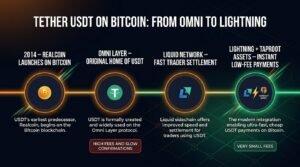
Many newcomers are surprised to learn that Tether did not start on Ethereum. The project first appeared in 2014 under the name Realcoin, and developers built it on the Bitcoin blockchain using the Omni protocol. The team later renamed it Tether, and people used USDT as the main token to move dollar value between exchanges. At that time, stablecoins were a new idea, and Bitcoin was the safest base layer available. As the market grew, Tether expanded to other chains. However, its early Bitcoin history explains why the connection between USDT and Bitcoin still matters today.
Omni Layer: The Original Home of USDT
The Omni Layer is a protocol that sits on top of Bitcoin and enables users to create and transfer tokens using regular Bitcoin transactions. When you sent USDT through Omni, the Bitcoin blockchain itself stored the details of the transfer. This gave early USDT strong security, but it also created problems. Each transfer needed a Bitcoin transaction fee, and those fees became expensive when the network was busy. Confirmation times were also slow compared with newer chains. Because of these limits, most users and exchanges gradually moved their USDT activity to cheaper networks. You can read more about the protocol on the official Omni Layer website.
Tether USDT on Bitcoin Through the Liquid Network
The Liquid Network is a Bitcoin sidechain built mainly for traders, exchanges, and institutions. It allows assets like USDT to move much faster than on the main Bitcoin chain, with confirmations that take only a short time. Liquid also supports confidential transactions, which hide the amounts being sent from public view. Tether USDT on Bitcoin through Liquid is popular with market makers who need quick settlement between platforms. Users lock Bitcoin-related assets into the system and receive tokens that can be used on the sidechain. The model depends on a federation of members, so it has a different trust structure than Bitcoin itself.
USDT on Bitcoin Lightning and Taproot Assets
The Lightning Network is Bitcoin’s best-known layer for instant and low-cost payments. Tether announced that USDT can be used on Lightning through Taproot Assets, a protocol developed with Lightning Labs. This means stablecoin payments can travel across the same channels that already carry Bitcoin payments. For businesses and everyday users, the idea is attractive because fees stay very small and settlement is nearly immediate. It also helps people in countries with unstable currencies to send dollar value quickly. Adoption is still growing, and wallet support will decide how fast this option becomes common.
RGB Protocol and Private Stablecoin Transfers
RGB is another approach for bringing tokens to Bitcoin. Client-side validation keeps most contract data off the blockchain and allows only the parties involved in a transfer to check it. This design can improve privacy and reduce the load on the Bitcoin network. Tether has announced support for USDT on RGB, showing strong interest in building stablecoin tools around Bitcoin. Developers like RGB because it can work with both on-chain Bitcoin and the Lightning Network. The technology is still young, so users should expect changes, new wallets, and improvements over time as the ecosystem matures.
Benefits of Using Tether USDT on Bitcoin
There are several clear advantages to using Tether USDT on Bitcoin. First, you can hold a stable asset without leaving the Bitcoin environment, which is helpful during sharp market moves. Second, newer layers such as Lightning and Liquid offer lower fees and faster payments than the old Omni method. Third, businesses that already accept Bitcoin can add stablecoin payments with less friction. Finally, people in regions with high inflation can protect their savings in dollar terms while still using Bitcoin tools. These benefits explain why developers keep investing in this area, even though other chains are currently larger.
Risks and Limitations to Keep in Mind
No system is risk free, and Tether USDT on Bitcoin has several limits worth knowing. Tether is a centralized issuer, so it can freeze addresses,s and its reserves depend on the company’s management. Sidechains like Liquid rely on a federation, which adds trust assumptions. Newer technologies such as Taproot Assets and RGB may have fewer wallets and less liquidity. Users can also lose funds by sending tokens to the wrong network or an unsupported address. Always test with a small amount first, confirm which network your wallet or exchange supports, and read the official Tether website for current details.
How to Choose the Right Network for USDT
Choosing the right network depends on your goal. If you need fast trading settlement, Liquid may be a good fit; if you want cheap everyday payments, Lightning with Taproot Assets could be more suitable once your wallet supports it. If privacy matters most, RGB deserves attention as it develops. For most beginners, the safest path is to use a trusted exchange that clearly lists supported networks. Compare fees, speed, and wallet support before every transfer. You can also read our beginner guide to stablecoins and our latest crypto news to stay updated on network changes.

FAQs About Tether USDT on Bitcoin
Is Tether USDT available on the Bitcoin network?
Yes. USDT first launched on Bitcoin in 2014 through the Omni Layer. Today, the Liquid Network also supports it, and Tether has announced that it supports Lightning via Taproot Assets and the RGB protocol.
Which network is best for Tether USDT on Bitcoin?
It depends on your goal. Liquid suits fast trading settlement, Lightning suits cheap everyday payments, and RGB suits users who want more privacy. Omni is mostly a legacy option now.
Is USDT on the Omni Layer still used?
Rarely. Omni transactions need Bitcoin fees, which can be high, and confirmations are slow. Most exchanges and users have moved to faster and cheaper networks.
Is Tether USDT on Bitcoin safe to use?
It can be, but there are risks. Tether is a centralized issuer that can freeze addresses, and sidechains like Liquid depend on a federation. Always test with a small amount first and confirm the network before sending.
Can I send Bitcoin-network USDT to an Ethereum or Tron address?
No. Each network is separate, and sending to the wrong one can cause permanent loss. Use an exchange that supports both networks, or a trusted bridge, to convert between them.
Final Thoughts on Tether USDT on Bitcoin
Tether USDT on Bitcoin has come a long way from its early days on the Omni Layer. Today, options like Liquid, Lightning, and RGB show that the Bitcoin ecosystem is working to support stablecoins in faster and more private ways. The technology is promising, but it is still developing, and users must understand both the benefits and the risks. Stay careful, double-check networks, and follow trusted sources for updates. For more daily crypto coverage, keep reading Cryptofylab. Also, check the Liquid Network website to learn how the sidechain works.