XRP Future Scope: Will Banks and Payment Firms Drive Mass Adoption?
Examining cross-border payments, regulation and real-world use cases behind XRP’s long-term potential


The future scope of XRP is a topic that attracts strong opinions from supporters and critics alike. XRP is the native asset of the XRP Ledger, a blockchain designed for fast, low-cost transfers, and it is closely associated with cross-border payments. Banks and payment companies spend significant sums moving money between countries, often waiting days and paying high fees. XRP aims to improve that process. Whether financial institutions will adopt it at scale remains an open question. In this article on cryptol7.com, we examine the technology, the regulatory background, potential partnerships, and the risks, so you can form a balanced view of where XRP may be heading.
What XRP Is Designed to Do
To understand the XRP future scope, start with its purpose. The XRP Ledger was built to settle transactions in a few seconds at very low cost, using a consensus mechanism that does not rely on energy-intensive mining. XRP can act as a bridge asset, helping convert one currency into another without requiring both sides to hold large pre-funded accounts. This could free up capital that banks currently lock in foreign accounts. The technology is not just theoretical, because the network has processed a large volume of transactions over many years. Its design priorities of speed, efficiency, and scalability make it attractive for payment use cases rather than for complex smart contract applications.
The Problem With Traditional Cross-Border Payments
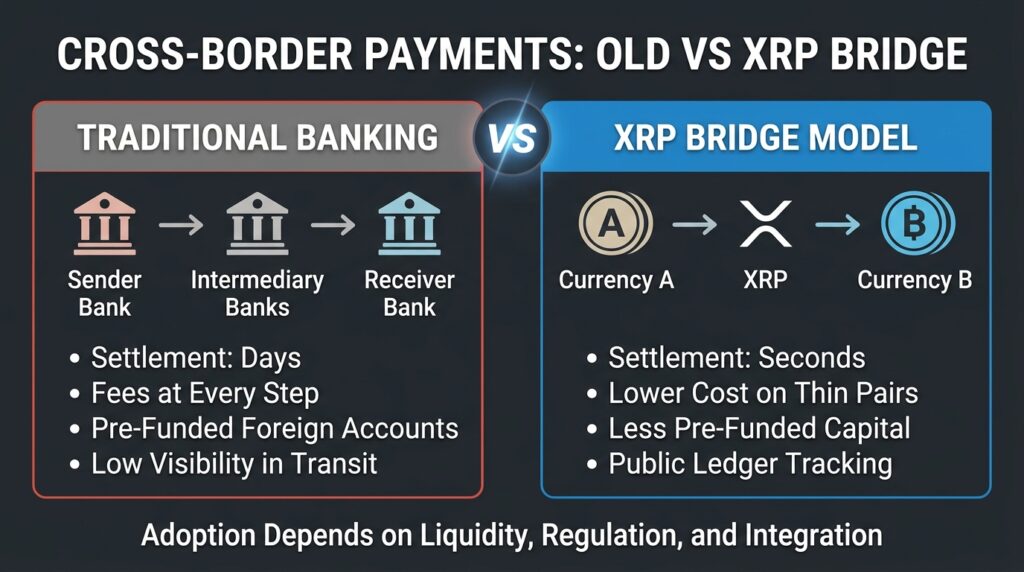
Sending money internationally often involves multiple intermediary banks, each adding fees and delays. Payments may take days to settle, and senders frequently cannot see exactly where the money is during transit. Businesses that pay overseas suppliers face high costs, while migrant workers sending remittances often lose a noticeable share to fees. Institutions also need to keep funds pre-positioned in different currencies, tying up liquidity. These pain points create a large market opportunity for any technology that can make settlement faster and cheaper. The XRP future scope is closely linked to whether solutions like this can prove reliable and compliant enough for regulated financial institutions.
How XRP Aims to Solve It
XRP can serve as an intermediary asset, allowing a payment to move from one currency to XRP and then into another currency within seconds. This process reduces the need for pre-funded accounts and can lower costs, especially for less liquid currency pairs. The technology also offers transparency, since transactions are recorded on a public ledger. For banks, this could mean improved tracking and quicker reconciliation. However, adoption depends on liquidity depth, regulatory comfort,t and integration with existing systems. A strong XRP future scope requires not only good technology but also practical, secure, re and compliant ways for institutions to use it every day.
Banks and Payment Firms: The Adoption Question
Institutional adoption is the central factor in the XRP future scope. Large banks tend to move slowly because of regulation, risk management, ent and legacy infrastructure. Even when a new technology is promising, testing, compliance reviews,iews and integration can take years. Payment firms are often more agile and may adopt new rails sooner, especially if they can reduce costs for customers. Partnerships and pilot programs are therefore worth watching, but announcements should be checked carefully, because not every partnership involves actual XRP usage. Investors who verify details through official sources avoid confusing marketing language with genuine, large-scale adoption.
Partnerships and Pilot Programs
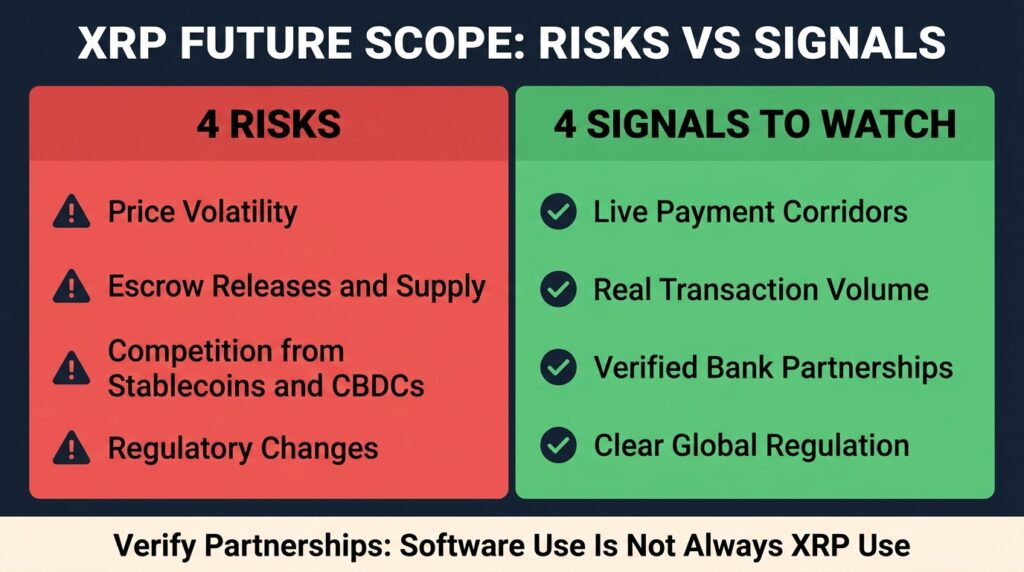
Ripple, the company associated with XRP, has announced collaborations with various financial institutions and payment providers over the years. Some partners tested its payment software, while only some used XRP for liquidity. This difference matters, because software adoption does not automatically create demand for the token. Pilot programs can be encouraging, but they must evolve into live, high-volume corridors to meaningfully influence the XRP future scope. Following official announcements and independent reporting helps investors separate substantive progress from hype. Real adoption tends to show up in transaction data and regular usage rather than only in press releases or social media excitement.
Central Bank Digital Currencies and Competition
Central banks around the world are exploring digital currencies, and some of these projects may influence cross-border settlement. This could create both opportunities and competition for XRP. If networks need a neutral bridge between different digital currencies, XRP-like solutions might find a role. On the other hand, governments may prefer their own systems, reducing space for private assets. Competing blockchains and stablecoins also target payments, which means XRP must prove it offers distinct advantages. Evaluating the XRP future scope realistically requires acknowledging this competition and tracking how financial infrastructure evolves rather than assuming one winner is guaranteed.
Regulation and Legal Clarity
Regulation has had a major effect on the XRP future scope. Legal disputes in the United States created uncertainty for years, influencing exchange listings and institutional willingness to engage. Greater clarity can encourage participation, while renewed uncertainty can discourage it. Because rules differ by country, XRP’s prospects also vary by region, with some jurisdictions offering clearer frameworks than others. Investors should follow credible news sources and official legal documents instead of rumors. As global standards for digital assets develop, assets that fit clearly within compliance frameworks may gain an advantage when banks decide where to allocate resources.
Lessons From the SEC Case
The long legal dispute with the U.S. Securities and Exchange Commission showed how regulatory classification can shape a token’s market access. During the case, some platforms paused trading, which affected liquidity and sentiment. Developments in court decisions influenced price movements and public debate about how crypto should be regulated. You can follow official updates directly from the SEC website. The broader lesson is that legal clarity is as valuable as technology for institutional adoption. Any realistic view of the XRP future scope must account for how regulators treat the token now and how rules may continue changing.
Global Regulatory Trends
Outside the United States, regions such as the European Union, the United Kingdom, Japan, Singapore, and the United Arab Emirates are building frameworks for digital assets. Clear licensing and consumer protection rules can make banks more comfortable using crypto-based tools. Divergent regulations may also create fragmentation, forcing companies to adapt their approach by country. Positive developments in major financial hubs can support the XRP future scope, while restrictive policies may slow progress. Watching these trends gives investors a better understanding of where adoption is most likely to occur first and which markets may become key payment corridors.
Risks and Realistic Expectations
A balanced view of the XRP future scope must include risks. Price is volatile, and adoption may progress more slowly than supporters hope. Competing technologies could capture market share, and regulatory changes can alter the landscape quickly. Another factor is token distribution, since a significant portion of XRP supply is held in escrow by Ripple and released over time, which some investors view as a source of potential selling pressure. None of these points mean XRP cannot succeed, but they highlight why careful research and risk management are essential before investing.
Market Volatility and Token Supply
XRP’s price can swing sharply on news about lawsuits, partnerships,rships or overall crypto sentiment. Its large total supply means that price targets quoted online may not reflect realistic market capitalization requirements. For example, a very high price would imply a market value far above many established assets, so claims should be checked with simple math. Understanding circulating supply, escrow releases,eleases and trading volume helps investors stay grounded. Using tools like CoinMarketCap to review supply data supports more informed decisions about XRP’s future scope instead of following exaggerated predictions.
How to Evaluate XRP Responsibly
Responsible evaluation means diversifying, avoiding money you cannot afford to lose, and relying on verified information. Study transaction volumes on the ledger, watch for live payment corridors,s and review regulatory developments. Be skeptical of guaranteed return claims or influencers promising massive gains. Consider dollar-cost averaging rather than investing everything at once, and set clear rules for taking profits and limiting losses. The XRP future scope may be promising, but patience and discipline are more useful than speculation. This article is educational and does not provide financial advice.
FAQs
1. What is the XRP future scope?
The XRP future scope centers on cross-border payments, where XRP could help banks and payment firms settle transfers faster and cheaper. Outcomes depend on adoption, regulation, and competition.
2. Can banks really use XRP?
Some institutions have tested Ripple’s technology, and XRP can serve as a bridge asset. Wide bank adoption requires regulatory comfort, integration,n and proven liquidity.
3. Does regulation affect XRP’s future?
Yes. Legal clarity influences exchange access, institutional participation, and investor confidence, so regulatory news can strongly affect XRP’s outlook.
4. Is XRP a good long-term investment?
It has real-world payment use cases, but it is volatile and uncertain. Do your own research, diversify,ersify and invest only what you can afford to lose.
Conclusion
The XRP future scope rests on whether banks and payment firms embrace faster, cheaper cross-border settlement, and whether regulation stays supportive. XRP offers compelling technology for payments, yet adoption must move beyond pilots; competition is intensifying, ing and legal conditions remain important. Investors should track real usage data, verify partnership claims, and manage risk carefully. For more crypto insights and analysis, keep reading cryptol7.com. This content is for educational purposes only and is not financial advice.