
Litecoin (LTC) Future Scope: ETF Hopes, Payments Use, and Network Growth
How ETF hopes, fast payments, and steady network growth shape the long-term outlook for LTC

The Litecoin future scope has become a popular topic as investors look beyond Bitcoin for assets with clear, practical use cases. Charlie Lee launched Litecoin in 2011 as a faster and lighter companion to Bitcoin, and the network has run without major failures for well over a decade. That long record gives LTC a level of trust that many newer tokens still lack. Today, three themes drive the conversation: possible exchange-traded fund approvals, growing payments adoption, and steady upgrades to the network. At the same time, Litecoin faces tough competition from stablecoins, faster blockchains, and a market that often rewards new stories over old ones. This article explains how Litecoin works, what supports its outlook, which risks matter, and how long-term investors can think about it. You will also find clear answers to common questions at the end. Read each section carefully before you make any decision.
What Is Litecoin (LTC)?
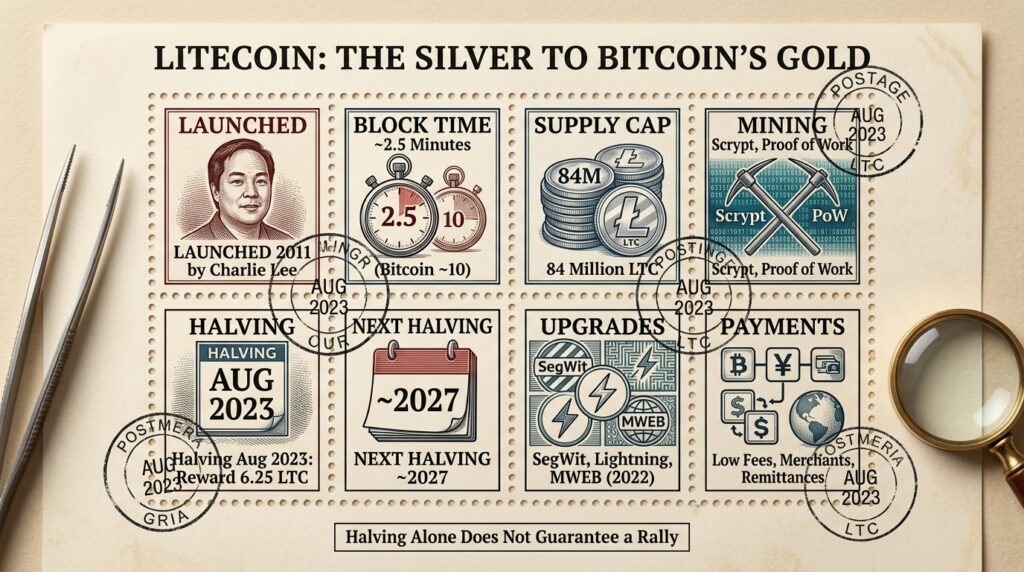
Litecoin is an open-source, decentralized cryptocurrency that lets people send value directly without banks or payment processors. Charlie Lee, a former Google engineer, created it by modifying the Bitcoin code to improve speed and accessibility. The network produces a new block roughly every 2.5 minutes, compared with about ten minutes on Bitcoin, so confirmations arrive faster. Litecoin uses the Scrypt mining algorithm, which originally aimed to keep
mining open to ordinary computers. Over time, specialized hardware took over, as happened with Bitcoin. The protocol caps total supply at 84 million coins, four times the Bitcoin limit, and that cap makes th
e asset scarce by design. Many people describe Litecoin as “silver to Bitcoin’s gold” because it targets smaller everyday payments rather than pure long-term storage. The network has no central company controlling it, and the Litecoin Foundation supports development and awareness. You can learn more about the project on the official Litecoin website. For more market guides, browse the latest articles on cryptol7.com.
How Litecoin Works: Speed, Fees, and Mining
Litecoin runs on a proof-of-work system, which means miners compete to add blocks by spending computing power. This process secures the network because rewriting history would cost an attacker enormous resources. Faster block times let users see confirmations sooner, which suits point-of-sale payments and quick transfers. Transaction fees usually stay low, and many simple transfers cost only a small fraction of a dollar. The network also supports SegWit and the Lightning Network, which improve capacity and enable even faster small payments. Miners earn block rewards, and those rewards drop by half roughly every four years in an event called the halving. The halving in August 2023 cut the reward to 6.25 LTC per block, and the next one is expected around 2027. Each halving slows new supply and has often drawn market attention. Mining power, known as hash
rate, has reached strong levels in recent years, and that trend supports security. Investors can check live supply and market data on CoinMarketCap’s Litecoin page.
The Halving and Scarcity Story
The halving plays a major role in Litecoin’s future scope because it reduces how many new coins enter the market. Litecoin started with a block reward of 50 LTC, and every halving since has cut that amount in half. Fewer new coins mean less selling pressure from miners, who often sell rewards to pay for equipment and electricity. If demand stays steady or grows, a shrinking supply can support price over time. Past halvings drew strong interest, but price results varied because market conditions differed each time. The next halving will matter again, and traders will likely position early. Still, a halving alone does not guarantee a rally, since demand must also rise. Investors should treat it as one supportive factor, not a promise. Scarcity helps only when real users and investors want the asset. A careful investor tracks both supply changes and adoption trends together.
Litecoin ETF Hopes: A Potential Catalyst
Exchange-traded funds have become one of the biggest themes in crypto, and Litecoin is
ts on the list of assets that issuers have explored. Spot Bitcoin and Ether ETFs opened regulated access for traditional investors, and many market watchers now ask which assets could follow. Asset managers have filed or discussed Litecoin products with regulators, and the market has watched those filings closely. A spot ETF would let investors buy LTC exposure through a normal brokerage account, and that convenience could bring new capital. Approval would also give Litecoin a stronger sense of legitimacy among conservative investors. Timing and outcomes depend on regulators, and decisions can arrive later than traders expect. Readers should check current regulatory news and issuer announcements, because the status can change quickly. Even if a fund launches, inflows will depend on investor appetite, and smaller assets often attract smaller flows than Bitcoin. ETF hopes can lift sentiment, but disappointment can also hurt it. Treat this catalyst as possible and uncertain, not as a done deal.
Payments Use and Real-World Adoption
Payments remain the core of Litecoin’s future scope, because the network was built for fast and cheap transfers. Several payment processors and merchants accept LTC, and some crypto debit cards let users spend it at regular stores. Litecoin has also gained attention for its steady performance during busy market periods, since the network handles traffic without long delays. Its low fees make it practical for smaller transactions where high costs would otherwise discour
age use. Remittances offer another promising area, as people can move value across borders without large intermediary charges. The Mimblewimble Extension Blocks upgrade, known as MWEB, launched in 2022 and added optional privacy features for users who want them. That upgrade also drew debate, since some exchanges review privacy tools carefully. Payments competition remains fierce, because stablecoins on fast networks now handle much of the everyday crypto payment volume. Litecoin must keep proving that its simplicity and reliability offer real advantages. Adoption data, merchant growth, and active addresses help investo
rs judge whether it succeeds.
Litecoin vs. Stablecoins and Faster Chains
Stablecoins have changed the payments conversation because users can send dollar-pegged value without worrying about price swings. Many merchants and users prefer that stability over a volatile asset like LTC. Faster blockchains such as Solana and several layer-2 networks also offer very low fees and quick finality. Litecoin cannot beat every rival on raw speed, so it relies on simplicity, security, and a long
operating record. Its volatility remains a challenge for everyday spending, since price changes can affect the value a merchant receives. Payment processors often solve this by converting LTC to cash instantly. Litecoin can still serve users who value decentralization and a simple monetary policy. The network may also benefit from integrations that bundle several coins in one payment option. Investors should watch whether LTC keeps its share of crypto payments or loses ground to stablecoin rails. A realistic view of this competition protects you from overly optimistic forecasts.
Network Growth and Development
Network growth gives investors real data to judge Litecoin beyond price. Active addresses, transaction counts, and hash rate show how many people use and secure the chain. Litecoin has posted strong transaction activity in some periods, which suggests steady demand for simple transfers. Development moves at a calm pace because the community prefers careful upgrades over rapid change. That approach reduces risk, but it also means fewer headline-grabbing features than newer networks offer. The Litecoin Foundation promotes education, partnerships, and ecosystem support, and independent developers contribute code and tools. Exchanges list LTC widely, which gives the asset deep liquidity and easy access. Wallet support is also broad, so users can store coins on hardware devices, mobile apps, and desktop software. This wide support helps Litecoin stay accessible even when market attention shifts. Long-term investors should follow upgrade proposals, merchant announcements, and on-chain activity to track real progress. Steady growth in these areas strengthens the foundation of Litecoin’s future scope.
Key Risks to Consider Before You Invest
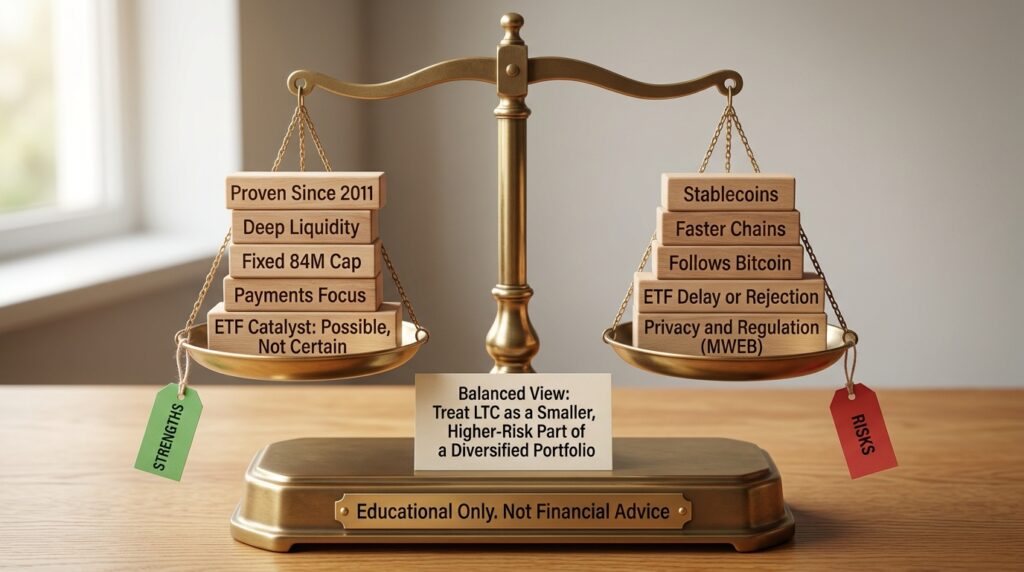
Litecoin’s future scope carries several risks that every investor should weigh against its strengths. Competition tops the list, since rival networks and stablecoins attract developers, merchants, and users with fresh features. A lack of a strong smart contract ecosystem limits Litecoin’s role in decentralized finance and new app trends. Market risk also matters, because LTC often falls sharply when Bitcoin and the wider market decline. Narrative risk adds pressure, as investors may see Litecoin as an older asset with less growth potential than newer projects. ETF delays or rejections could damage sentiment if traders already priced in approval. Mining centralization and reliance on large mining pools can raise concerns about network control. Security risks also exist for users, since lost keys, phishing, and weak exchange security can cause permanent losses. Liquidity usually stays healthy, but thin order books can still magnify moves during stress. None of these risks make LTC a poor choice by default, but they call for careful position sizing. Never invest money you cannot afford to lose.
Regulatory and Privacy Risks
Regulation affects every cryptocurrency, and Litecoin must navigate those rules like everyone else. Authorities in different countries treat crypto assets differently, and those rules can change after elections or major market events. Litecoin has often received favorable treatment as a commodity-like asset, but outcomes depend on future decisions. The MWEB privacy feature adds a separate layer of scrutiny, because regulators and exchanges examine tools that hide transaction details. Some platforms have limited or delisted privacy-focused assets in certain regions, so access can vary. Tax rules also matter, since trading, spending, or earning LTC can create taxable events in many countries. Clear rules would help institutional adoption, but timing remains uncertain. Investors should check local laws, exchange policies, and tax duties before they buy or use LTC. This Litecoin future scope analysis cannot replace professional advice, so consult a qualified advisor for your own situation. Staying informed helps you avoid costly mistakes.
Long-Term Potential: Is Litecoin a Good Investment?
Litecoin offers a long track record, deep liquidity, a fixed supply cap, and a clear focus on payments. Those strengths give it a stable place in the crypto market, even when attention moves to newer trends. Potential catalysts include ETF approval, the next halving, and wider merchant adoption. The asset also benefits from simple technology that users and exchanges already understand well. On the other side, growth depends on whether Litecoin can keep relevance against stablecoins and faster networks. Price performance has often followed Bitcoin, which limits independent upside during weak markets. Bulls see a proven payments coin with room for rediscovery, and bears see an aging project with limited innovation. A balanced investor might treat LTC as a smaller, higher-risk part of a diversified portfolio. Dollar-cost averaging and secure storage can reduce timing risk and custody mistakes. This article gives information only, not financial advice, so research current data before you act.
FAQs About Litecoin Future Scope
What is Litecoin used for?
Litecoin mainly serves as a fast, low-cost digital payment method. People also hold it as an investment and use it for cross-border transfers.
Will a Litecoin ETF be approved?
Approval depends on regulators, and timing remains uncertain. Check current news and official filings for the latest status.
How many Litecoin coins will exist?
The protocol caps total supply at 84 million LTC. Halvings reduce new issuance about every four years.
Is Litecoin a good long-term investment?
Litecoin has a long track record and a clear payments focus, but it faces competition and market risk. Each investor should research current data and match any purchase to personal risk tolerance.
What are the biggest risks of investing in Litecoin?
The main risks include competition from stablecoins, market volatility, regulatory change, and security mistakes by users. Careful position sizing and safe storage help manage them.
Conclusion on Litecoin Future Scope
Litecoin stands out as a proven, fast, and low-cost network with a clear payments focus. ETF hopes, the upcoming halving, and steady network growth support the long-term case. Competition, regulation, and market swings still demand discipline and careful planning. This Litecoin future scope review suggests that LTC suits patient investors who follow adoption trends and manage risk wisely. Do your own research, diversify your holdings, and rely on official sources for current data. For more Litecoin Future scope, analysis, and guides, visit cryptol7.com.