Must-Have Altcoin Holdings for 2026: Ethereum, Solana, Cardano
Discover the must-have altcoin holdings for 2026 including Ethereum, Solana, and Cardano. Expert analysis reveals top crypto investments.

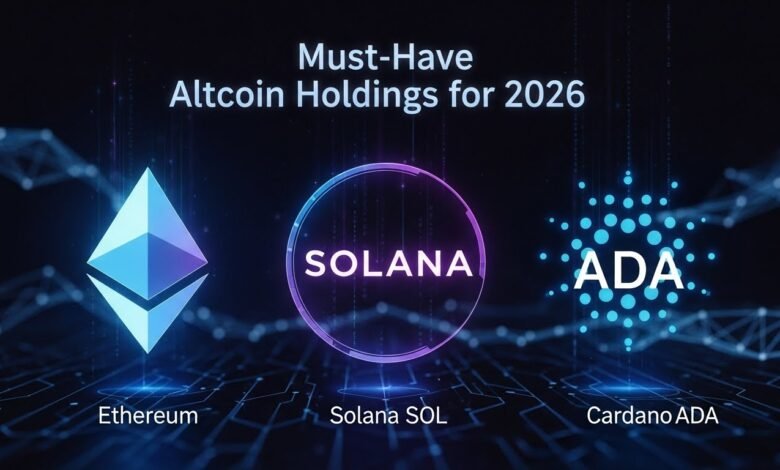
Altcoin holdings for 2026 has become increasingly crucial for investors seeking substantial returns. Industry experts have recently spotlighted three blockchain powerhouses that stand out from the crowded field: Ethereum, Solana, and Cardano. These digital assets represent more than just speculative investments; they embody fundamental technological innovations that are reshaping decentralized finance, smart contract capabilities, and blockchain scalability. According to leading cryptocurrency analysts, these three platforms have demonstrated remarkable resilience through market volatility while maintaining strong development activity and growing adoption rates. Understanding why these particular altcoins for 2026 have earned their place at the top of expert portfolios requires examining their unique value propositions, technological advantages, and real-world applications that continue attracting both institutional and retail investors.
Why Ethereum Remains Among Top Altcoin Holdings for 2026
Ethereum’s position as a cornerstone in any serious cryptocurrency portfolio for 2026 stems from its undisputed dominance in the smart contract ecosystem. Since transitioning to proof-of-stake consensus through the historic Merge event, Ethereum has dramatically reduced its energy consumption by approximately ninety-nine percent while simultaneously improving its network security and decentralization. The platform currently hosts over four thousand decentralized applications spanning decentralized finance, non-fungible tokens, gaming, and enterprise solutions, creating an unmatched ecosystem effect that competitors struggle to replicate.
The Ethereum network processed over one point five million transactions daily throughout early 2026, demonstrating sustained user engagement despite competition from newer blockchain platforms. What truly distinguishes Ethereum as one of the best altcoins to hold in 2026 is its layer-two scaling solutions, including Optimism, Arbitrum, and Base, which have successfully addressed previous concerns about transaction costs and processing speeds. These layer-two networks effectively multiply Ethereum’s throughput while maintaining the security guarantees of the main chain, creating a scalable infrastructure capable of supporting mainstream adoption.
Institutional adoption continues strengthening Ethereum’s investment thesis, with major financial institutions developing Ethereum-based products and services. The approval of spot Ethereum exchange-traded funds in multiple jurisdictions has provided traditional investors with regulated access to ETH exposure, channeling significant capital into the ecosystem. Furthermore, Ethereum’s ongoing development roadmap, including proto-danksharding and full danksharding implementations, promises to enhance data availability and reduce layer-two costs even further, positioning the network for sustained growth throughout the remainder of this decade.
Solana’s High-Performance Blockchain Secures Position in Must-Have Altcoin Holdings for 2026
Solana has emerged as a formidable contender in the top altcoin investments for 2026 category by delivering exceptional transaction throughput that rivals traditional payment processors. The network consistently processes between three thousand and five thousand transactions per second with average transaction costs remaining below one cent, making it particularly attractive for applications requiring high-frequency interactions. This performance advantage has attracted developers building consumer-facing applications, decentralized exchanges, and gaming platforms that demand responsive user experiences without prohibitive fees.
The Solana ecosystem experienced remarkable growth throughout 2025 and into 2026, with total value locked in Solana-based DeFi protocols surpassing fifteen billion dollars. This growth reflects genuine utility rather than speculative enthusiasm, as users increasingly recognize the practical advantages of transacting on a network that combines speed, affordability, and security. Notable projects like Jupiter, Jito, and Marinade Finance have demonstrated that Solana can support sophisticated financial applications while maintaining the decentralization principles essential to blockchain technology.
Solana’s mobile strategy represents another differentiating factor making it essential among altcoin holdings for 2026. The Solana Mobile Stack and Saga smartphone initiative have pioneered cryptocurrency integration directly into consumer hardware, creating seamless experiences for users who might otherwise find blockchain technology intimidating. This mobile-first approach positions Solana to capture the next billion cryptocurrency users as smartphone penetration continues expanding globally. Additionally, Solana’s validator network has grown increasingly robust, with over two thousand active validators contributing to network security and decentralization, addressing previous concerns about centralization that plagued earlier iterations of the platform.
Cardano’s Research-Driven Approach Justifies Inclusion in Top Altcoin Holdings for 2026
Cardano distinguishes itself among cryptocurrency investments for 2026 through its methodical, peer-reviewed approach to blockchain development. Founded by Ethereum co-founder Charles Hoskinson, Cardano has prioritized academic rigor and formal verification methods to ensure its protocol upgrades are secure and thoroughly tested before implementation. This conservative development philosophy has sometimes resulted in slower feature rollouts compared to competitors, but it has also created a robust foundation that minimizes security vulnerabilities and protocol failures.
The Cardano network completed several significant upgrades throughout 2025, enhancing its smart contract capabilities and interoperability features. The implementation of Hydra scaling solution has begun delivering the promised performance improvements, with individual Hydra heads capable of processing over one thousand transactions per second while settling final state to the main chain. This layered approach to scalability mirrors Ethereum’s strategy but with Cardano’s unique extended unspent transaction output model providing different security and efficiency trade-offs.
What makes Cardano particularly compelling as one of the must-have altcoins for 2026 is its strong focus on emerging markets and real-world utility. The platform has secured partnerships with governments and educational institutions across Africa, South America, and Asia, implementing blockchain-based identity solutions, credential verification systems, and financial infrastructure. These practical applications demonstrate blockchain’s potential to address genuine societal challenges rather than serving purely speculative purposes. Furthermore, Cardano’s treasury system, funded through transaction fees and monetary expansion, ensures sustainable development funding without relying solely on foundation reserves, creating a self-sustaining ecosystem capable of long-term innovation.
Comparative Analysis: Ethereum vs Solana vs Cardano for 2026 Portfolios
When evaluating these three platforms as strategic altcoin holdings for 2026, investors must consider their distinct technological approaches and market positioning. Ethereum offers unmatched ecosystem depth and institutional adoption, functioning as the blue-chip option within the smart contract platform category. Its extensive developer community, established DeFi infrastructure, and regulatory clarity in major markets provide stability and reduced execution risk for projects building on the network.
Solana presents the high-performance alternative, sacrificing some degree of decentralization and hardware requirements for superior transaction throughput and user experience. This trade-off appeals particularly to consumer applications, gaming projects, and high-frequency trading platforms where responsiveness and cost efficiency are paramount. Solana’s rapid iteration and willingness to implement aggressive scaling solutions position it as the growth-oriented option for investors comfortable with higher technological risk in exchange for potentially greater returns.
Cardano occupies the methodical, research-focused position, appealing to investors who prioritize long-term sustainability and real-world utility over short-term performance metrics. Its formal verification processes and emphasis on emerging market adoption create a unique value proposition distinct from both Ethereum and Solana. For portfolio construction purposes, the optimal altcoin strategy for 2026 likely involves exposure to all three platforms rather than selecting a single winner, as they address different market segments and use cases within the broader blockchain ecosystem.
Expert Perspectives on Must-Have Altcoin Holdings for 2026
Leading cryptocurrency analysts have consistently highlighted these three platforms when discussing essential altcoin investments for 2026. According to research from major digital asset firms, portfolio allocations favoring established layer-one blockchains with proven track records tend to outperform strategies concentrated in newer, unproven projects during both bull and bear market conditions. This risk-adjusted return profile makes Ethereum, Solana, and Cardano particularly attractive for investors seeking cryptocurrency exposure without excessive volatility.
Market analysts point to several macroeconomic factors supporting the altcoin investment thesis for 2026. Continued institutional adoption, clearer regulatory frameworks in major jurisdictions, and improving cryptocurrency infrastructure have reduced barriers to entry for traditional investors. Additionally, the maturation of decentralized finance has created genuine yield-generating opportunities that extend beyond pure price speculation, providing fundamental value propositions that justify long-term holdings.
Technical analysts examining on-chain metrics highlight positive indicators across all three networks. Ethereum’s active address count has maintained steady growth, while transaction fee revenues demonstrate sustained demand for block space. Solana’s network uptime has significantly improved following infrastructure upgrades, addressing previous reliability concerns that deterred some institutional participants. Cardano’s steady increase in delegated stake and smart contract deployments indicates growing developer confidence in the platform’s capabilities. These on-chain fundamentals support expert recommendations that these platforms represent core altcoin holdings for 2026 portfolios.
Risk Factors and Portfolio Allocation Strategies for 2026 Altcoin Holdings
Despite their strong fundamentals, investors must acknowledge the risks inherent in holding these altcoins throughout 2026. Regulatory uncertainty remains a persistent concern, particularly regarding securities classification and taxation policies that vary significantly across jurisdictions. While Ethereum has gained some regulatory clarity through ETF approvals, Solana and Cardano face ongoing scrutiny that could impact their market performance if unfavorable regulatory determinations emerge.
Technological competition represents another risk factor. New blockchain platforms continuously emerge with promises of superior performance, security, or decentralization. While Ethereum, Solana, and Cardano currently maintain strong positions, breakthrough innovations from competitors could potentially disrupt their market dominance. Additionally, each platform faces specific technical challenges: Ethereum must successfully implement its ambitious roadmap upgrades, Solana must maintain network stability as usage increases, and Cardano must accelerate development pace to remain competitive.
For constructing diversified altcoin portfolios for 2026, financial advisors typically recommend allocating between fifteen and thirty percent of cryptocurrency holdings to established layer-one platforms, with the remainder distributed across Bitcoin, emerging altcoins, and stablecoins depending on individual risk tolerance. Within the layer-one allocation, a balanced approach might allocate forty percent to Ethereum given its market leadership, thirty-five percent to Solana for growth exposure, and twenty-five percent to Cardano for its unique value proposition. However, these allocations should reflect individual financial situations, investment timelines, and risk preferences rather than serving as universal recommendations.
DeFi Ecosystem Strength and Its Impact on 2026 Altcoin Value
The decentralized finance landscape built atop these platforms significantly influences their value propositions as must-have altcoin holdings for 2026. Ethereum continues dominating DeFi with over sixty percent of total value locked across all blockchains, hosting established protocols like Aave, Uniswap, and Maker that have processed billions in transaction volume. This DeFi dominance creates network effects where liquidity attracts more liquidity, making Ethereum increasingly difficult to displace despite technical limitations.
Solana’s DeFi ecosystem has grown remarkably, with decentralized exchanges like Jupiter processing daily volumes comparable to centralized exchanges. The network’s speed advantages enable sophisticated trading strategies and arbitrage opportunities impossible on slower chains, attracting professional traders and market makers. Additionally, Solana-based lending protocols have demonstrated they can offer competitive yields while maintaining security, gradually building the trust necessary for institutional participation.
Cardano’s DeFi ecosystem, while smaller than Ethereum’s or Solana’s, has shown consistent growth as developer tools mature and smart contract capabilities expand. Projects like Minswap and Liqwid Finance have proven Cardano can support functional DeFi applications, though liquidity remains limited compared to more established ecosystems. The platform’s unique advantages around predictable transaction costs and extended UTXO model may attract specific DeFi use cases where these characteristics provide competitive advantages, potentially driving future ecosystem growth that justifies its position among top altcoin holdings for 2026.
NFT and Gaming Markets Driving Altcoin Adoption in 2026
Non-fungible tokens and blockchain gaming represent significant adoption drivers for these essential altcoins in 2026. Ethereum pioneered the NFT market and continues hosting the most valuable collections and marketplaces, with platforms like OpenSea, Blur, and Foundation facilitating billions in annual trading volume. The cultural significance and brand recognition of Ethereum-based NFT collections like CryptoPunks and Bored Ape Yacht Club create lasting value that extends beyond temporary market trends.
Solana emerged as a major NFT platform throughout 2024 and 2025, attracting creators and collectors with low minting costs and instant transaction finality. The Solana NFT ecosystem processed over two billion dollars in trading volume during 2025, demonstrating genuine market demand rather than isolated enthusiasm. Gaming projects particularly favor Solana’s performance characteristics, as blockchain games require responsive gameplay that slow transaction finality on other chains cannot adequately support.
Cardano’s NFT ecosystem has developed more gradually but with distinctive characteristics around royalty enforcement and metadata standards that appeal to artists concerned about long-term provenance tracking. Several notable artists have chosen Cardano specifically for its sustainability credentials and community values, creating a niche but dedicated collector base. As blockchain gaming and digital collectibles continue evolving throughout 2026, these altcoin platforms provide the infrastructure enabling creators to build sustainable businesses around digital assets.
Staking Rewards and Passive Income Opportunities in 2026
The ability to generate passive income through staking significantly enhances the investment case for these altcoin holdings in 2026. Ethereum’s transition to proof-of-stake enables holders to stake their ETH directly or through liquid staking protocols like Lido, earning approximately three to four percent annual rewards while contributing to network security. This yield generation transforms Ethereum from a purely speculative asset into an income-producing investment comparable to dividend-paying stocks or bonds.
Solana offers competitive staking yields ranging from five to eight percent annually, with relatively straightforward delegation processes that don’t require technical expertise. The network’s inflation schedule is designed to gradually decrease over time, creating predictable economics for long-term holders. Importantly, Solana staking maintains high liquidity through liquid staking derivatives, allowing participants to earn rewards while retaining the flexibility to trade or use their assets in DeFi applications.
Cardano pioneered liquid staking among major blockchains, allowing participants to delegate their ADA without lock-up periods while earning approximately four to five percent annual rewards. This design eliminates the opportunity cost concerns associated with illiquid staking mechanisms, making it particularly attractive for investors who want to maintain flexibility. The staking rewards available across these platforms create compelling reasons to maintain long-term altcoin positions throughout 2026, as the combination of potential price appreciation and passive income generation improves risk-adjusted returns compared to non-yielding assets.
Institutional Investment Trends Shaping Altcoin Markets in 2026
Institutional participation has dramatically increased across these cryptocurrency holdings for 2026, fundamentally changing market dynamics. Major investment firms, hedge funds, and even pension funds have begun allocating to digital assets, with Ethereum typically receiving the largest allocations due to its regulatory clarity and market liquidity. The approval and launch of spot Ethereum ETFs created accessible investment vehicles for institutions restricted from directly holding cryptocurrencies, channeling billions into the ecosystem.
Solana has attracted significant institutional interest from trading firms and market makers who appreciate its performance characteristics for high-frequency strategies. Venture capital firms have invested heavily in Solana ecosystem projects, providing capital that funds development and attracts talent. This institutional backing provides stability and resources that enhance Solana’s competitive position among top altcoin investments for 2026.
Cardano has cultivated relationships with governments and international organizations focused on blockchain applications in developing economies. While these partnerships may generate less immediate trading volume than DeFi or NFT activity, they establish long-term utility that could prove more sustainable than purely speculative drivers. The institutional validation from academic partnerships and government collaborations adds credibility that supports Cardano’s position among must-have altcoins for serious investors in 2026.
Technical Development and Roadmap Execution for 2026
Active development remains crucial for maintaining competitive advantages among these altcoin platforms in 2026. Ethereum’s development roadmap focuses on continued scaling improvements, with proto-danksharding (EIP-4844) successfully reducing layer-two costs and full danksharding promising further enhancements. The core developer community continues working toward ambitious goals around single-slot finality and quantum resistance, ensuring Ethereum remains technologically competitive for decades.
Solana’s development priorities include improving network stability through Firedancer, an independent validator client that will enhance decentralization and reliability. The engineering team continues optimizing the runtime environment to support even higher transaction throughput while reducing hardware requirements for validators. These technical improvements address previous criticisms while extending Solana’s performance advantages that justify its inclusion among essential altcoin holdings for 2026.
Cardano’s development has accelerated with the Voltaire governance phase implementation, giving the community direct control over protocol upgrades and treasury allocation. The introduction of partner chains enables projects to launch customized blockchains that leverage Cardano’s security while maintaining operational flexibility. This modular approach to ecosystem expansion could attract projects that require specific features unavailable on monolithic blockchain architectures, potentially driving adoption that supports Cardano’s valuation throughout 2026.
Global Adoption Metrics and Network Growth Indicators
Measuring real-world adoption provides essential context for evaluating these altcoin investment opportunities in 2026. Ethereum’s active address count exceeds five hundred thousand daily, with millions of unique addresses interacting with the network monthly. The platform hosts over four hundred billion dollars in stablecoin market capitalization, demonstrating its role as fundamental infrastructure for dollar-denominated digital transactions. These metrics indicate genuine utility rather than speculative interest alone.
Solana’s user growth has been particularly impressive, with new wallet creation rates consistently outpacing other major blockchains throughout 2025 and early 2026. The network’s focus on user experience and mobile integration has attracted demographics traditionally underserved by cryptocurrency, potentially positioning Solana for exponential growth as these users mature within the ecosystem. Daily active addresses have grown to over two million, reflecting the platform’s success in attracting and retaining users.
Cardano’s geographic distribution shows particular strength in regions where cryptocurrency addresses financial inclusion challenges. Active stake pool operation across one hundred countries demonstrates global decentralization rarely achieved by competing networks. While absolute user numbers remain smaller than Ethereum or Solana, Cardano’s growth trajectory and focus on sustainable adoption patterns support its position among strategic altcoin holdings for 2026.
Macroeconomic Factors Influencing Altcoin Performance in 2026
Broader economic conditions significantly impact the investment thesis for holding altcoins throughout 2026. Monetary policy decisions from major central banks affect cryptocurrency markets as investors reassess risk allocations based on interest rate environments. The current macroeconomic climate, characterized by moderating inflation and potential rate cuts, generally favors risk assets including cryptocurrencies, as investors seek higher returns than available from fixed-income securities.
Currency devaluation in various countries continues driving cryptocurrency adoption, with citizens seeking stable value stores as local currencies weaken. Ethereum, Solana, and Cardano all support stablecoin infrastructure that enables this use case, creating genuine demand that extends beyond speculative trading. Additionally, increasing correlation between cryptocurrency markets and traditional risk assets suggests that improving equity market conditions could provide tailwinds for altcoin valuations in 2026.
Geopolitical factors, including international sanctions and trade restrictions, have highlighted cryptocurrency’s utility for cross-border transactions resistant to political interference. While this raises regulatory concerns in some jurisdictions, it also demonstrates fundamental value propositions that extend beyond investment returns. These macroeconomic and geopolitical considerations support the case for maintaining diversified altcoin exposure through 2026 as both investment holdings and potential monetary alternatives.
Related Important Keywords and Search Intent
Investors researching must-have altcoin holdings for 2026 frequently search for related terms including best cryptocurrency investments 2026, top altcoins to buy now, crypto portfolio allocation strategies, Ethereum vs Solana comparison, Cardano price prediction 2026, altcoin staking rewards, DeFi platforms 2026, blockchain investment opportunities, cryptocurrency market analysis, digital asset portfolio management, proof-of-stake coins, smart contract platforms, layer-one blockchain comparison, crypto passive income strategies, institutional cryptocurrency investments, blockchain gaming tokens, NFT platform comparison, altcoin technical analysis, cryptocurrency fundamental analysis, and digital currency diversification strategies.
These search terms reveal that investors seek comprehensive information spanning fundamental analysis, technical comparisons, and practical portfolio construction guidance. The search intent indicates users want actionable intelligence rather than purely theoretical discussions, preferring content that helps them make informed allocation decisions based on current market conditions and future growth prospects.
Conclusion
As we progress through 2026, Ethereum, Solana, and Cardano have distinguished themselves as must-have altcoin holdings based on their technological foundations, ecosystem development, and real-world adoption metrics. These platforms represent different approaches to blockchain scalability and decentralization, providing investors with exposure to various segments of the cryptocurrency market. Ethereum offers established market dominance and institutional acceptance, Solana delivers high-performance infrastructure for consumer applications, and Cardano provides methodical development focused on sustainability and emerging markets.
Constructing a robust cryptocurrency portfolio for 2026 requires balancing these complementary platforms according to individual risk tolerance and investment objectives. The combination of potential price appreciation, passive staking income, and participation in revolutionary financial infrastructure creates compelling reasons to establish positions across these essential altcoins. However, investors must remain aware of regulatory risks, technological competition, and market volatility that characterize the cryptocurrency sector.
The expert consensus supporting these three platforms as core altcoin holdings for 2026 reflects their proven ability to deliver innovation while maintaining operational networks that process billions in transaction value. As blockchain technology continues maturing and integrating with traditional finance, Ethereum, Solana, and Cardano appear well-positioned to capture significant value throughout the remainder of this decade. Begin researching these must-have altcoin holdings for 2026 today and consider how they might strengthen your investment portfolio for the future of decentralized finance.
See more;Bitcoin Price Forecast: BTC Analysis & 2025 Predictions