
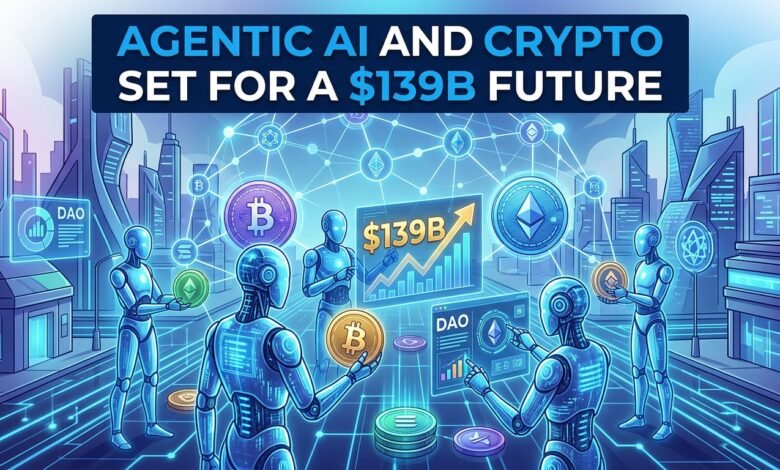
The rapid evolution of artificial intelligence and blockchain technology is creating one of the most transformative trends in the digital economy. As decentralized systems continue to mature and intelligent automation becomes more advanced, the convergence of Agentic AI and cryptocurrency is emerging as a powerful force capable of reshaping industries worldwide. Analysts and market observers now predict that the combined ecosystem could reach a staggering valuation of $139 billion by 2034, signaling a new era for finance, automation, and digital ownership.
The growing excitement around Agentic AI crypto projects is fueled by the increasing demand for autonomous systems that can perform tasks, make decisions, execute transactions, and interact with decentralized networks without constant human intervention. Unlike traditional AI models that mainly respond to prompts, Agentic AI systems can independently pursue objectives, learn from environments, and optimize actions in real time. When integrated with blockchain infrastructure, these systems gain transparency, security, and decentralized governance, creating entirely new possibilities for businesses and consumers alike.
The crypto industry has already experienced several innovation waves, including decentralized finance, NFTs, smart contracts, and Web3 applications. However, the arrival of Agentic AI may represent the next major leap. Investors, developers, and enterprises are increasingly exploring how autonomous AI agents can improve trading, automate decentralized applications, optimize blockchain operations, and revolutionize digital economies.
As global markets shift toward automation and intelligent systems, the relationship between AI-powered crypto ecosystems and decentralized technologies is becoming impossible to ignore. This article explores how Agentic AI is transforming cryptocurrency markets, why experts expect massive long-term growth, the opportunities and risks involved, and how this technological convergence could redefine the future of digital finance by 2034.
Understanding Agentic AI in the Crypto Industry
The term Agentic AI refers to artificial intelligence systems capable of acting autonomously to achieve specific goals. These AI agents can observe environments, analyze data, make decisions, and execute tasks with minimal human oversight. Unlike conventional AI chatbots or recommendation systems, Agentic AI possesses a higher degree of independence and adaptability.
In the crypto sector, this capability introduces groundbreaking possibilities. Blockchain networks operate continuously across global markets, generating massive amounts of data every second. Human traders, developers, and organizations often struggle to process this information efficiently. Agentic AI systems can bridge that gap by monitoring blockchain activity, analyzing trends, executing trades, and managing decentralized applications in real time.
The combination of blockchain technology and autonomous AI creates an ecosystem where intelligent agents can securely interact with decentralized protocols. Smart contracts enable AI systems to perform financial transactions transparently, while blockchain records provide immutable verification of actions and decisions.
This fusion is particularly attractive because crypto markets operate 24/7. Autonomous AI agents never sleep, allowing them to respond instantly to market volatility, liquidity shifts, and emerging investment opportunities. As decentralized ecosystems grow more complex, Agentic AI is increasingly viewed as an essential tool for scalability and efficiency.
Why the Agentic AI Crypto Market Is Growing Rapidly
The expected rise toward a $139 billion market valuation by 2034 is not happening by chance. Several powerful trends are accelerating growth within the AI and blockchain integration landscape.
One major factor is the rising adoption of decentralized finance platforms. DeFi ecosystems require constant monitoring of liquidity pools, lending rates, yield farming opportunities, and governance updates. Agentic AI systems can automate these functions, improving user experience while reducing inefficiencies.
Another driver is institutional interest. Major technology firms, venture capital investors, and blockchain startups are investing heavily in AI-powered crypto infrastructure. As enterprises seek smarter automation tools, the demand for decentralized AI solutions continues to increase.
The growing popularity of Web3 applications is also fueling expansion. Web3 platforms emphasize user ownership, decentralized governance, and digital identity management. Agentic AI agents can help users navigate these systems more effectively by automating interactions, managing assets, and optimizing decentralized workflows.
At the same time, advancements in machine learning, cloud computing, and blockchain scalability are making autonomous AI systems more practical and cost-effective. Faster blockchain networks and lower transaction fees create an environment where AI agents can operate efficiently at scale.
The convergence of these technologies is establishing a new digital economy centered around intelligent automation and decentralized infrastructure.
How Agentic AI Is Transforming Cryptocurrency Trading
One of the most immediate impacts of Agentic AI can be seen in cryptocurrency trading. Digital asset markets are known for extreme volatility, rapid price swings, and constant market activity. Human traders often struggle to react quickly enough to capitalize on opportunities or minimize losses.
Agentic AI trading systems are designed to overcome these limitations. These intelligent agents can analyze technical indicators, social sentiment, on-chain data, and macroeconomic developments simultaneously. They can then execute trades automatically based on predefined goals and adaptive learning models.
The use of AI crypto trading bots has already become widespread, but Agentic AI introduces a more advanced layer of autonomy. Instead of simply following fixed algorithms, autonomous AI agents can modify strategies dynamically as market conditions change.
For example, an Agentic AI system could detect increased whale activity on a blockchain network, analyze sentiment across social media platforms, evaluate liquidity conditions, and adjust portfolio allocations within seconds. This level of responsiveness may significantly improve efficiency and risk management for traders and investment firms.
The integration of decentralized exchanges further enhances this process. AI agents can interact directly with smart contracts, execute cross-chain swaps, and optimize yield opportunities without relying on centralized intermediaries.
The Role of Smart Contracts in AI Automation
Smart contracts serve as the backbone of many Agentic AI crypto applications. These self-executing agreements allow autonomous AI agents to interact with blockchain systems securely and transparently.
When combined with Agentic AI, smart contracts create programmable environments where intelligent systems can perform tasks independently. This includes executing financial transactions, managing digital assets, distributing rewards, and enforcing governance rules.
For instance, a decentralized autonomous organization could deploy AI agents to manage treasury operations automatically. The AI system could monitor market conditions, rebalance investments, and execute funding decisions according to predefined governance parameters.
This capability introduces unprecedented efficiency into decentralized ecosystems. Instead of relying solely on human administrators, organizations can leverage autonomous AI systems to handle routine operations while maintaining transparency through blockchain verification.
As the adoption of AI-driven smart contracts increases, industries beyond finance may also benefit. Supply chain management, healthcare, gaming, insurance, and digital identity systems are all exploring applications for intelligent blockchain automation.
Web3 and the Rise of Autonomous Digital Economies
The rise of Web3 is creating fertile ground for Agentic AI innovation. Web3 aims to establish a decentralized internet where users maintain ownership of their data, identities, and digital assets. However, navigating decentralized ecosystems can often be complex for average users.
Agentic AI systems simplify this experience by acting as intelligent digital assistants. These autonomous agents can manage crypto wallets, optimize DeFi strategies, participate in governance voting, and interact with decentralized applications on behalf of users.
This evolution could fundamentally change how people engage with digital economies. Instead of manually handling every blockchain interaction, users may increasingly rely on AI-powered assistants capable of executing tasks autonomously while protecting user preferences and security.
The gaming sector is another area experiencing rapid growth. Blockchain-based games and metaverse platforms are integrating AI agents that can interact with virtual economies, manage in-game assets, and enhance player experiences. These developments are helping create autonomous digital worlds powered by both AI and blockchain technology.
As Web3 ecosystems mature, the demand for scalable, intelligent automation tools is expected to rise dramatically.
Challenges Facing Agentic AI and Crypto Integration

Despite the enormous growth potential, the convergence of Agentic AI and cryptocurrency also presents several challenges that cannot be ignored.
One major concern is security. Autonomous AI systems capable of executing financial transactions could become targets for cyberattacks, manipulation, or exploitation. If poorly designed, AI agents may make harmful decisions or interact with malicious smart contracts.
Regulatory uncertainty also remains a significant obstacle. Governments worldwide are still developing policies regarding both AI governance and cryptocurrency regulation. The combination of these technologies raises complex legal and ethical questions concerning accountability, transparency, and data privacy.
Scalability is another issue. Many blockchain networks continue to face limitations related to transaction speed and operational costs. Agentic AI systems require substantial computational resources and rapid data processing, which may strain existing infrastructure.
There are also concerns surrounding bias and decision-making. AI systems learn from data, and flawed training datasets could lead to inaccurate or unfair outcomes. In decentralized finance environments, these errors could potentially result in substantial financial losses.
Addressing these risks will require collaboration between developers, regulators, cybersecurity experts, and blockchain communities to ensure responsible innovation.
Why Investors Are Paying Attention to Agentic AI Crypto Projects
Investor enthusiasm surrounding AI crypto tokens and Agentic AI platforms has grown significantly in recent years. Venture capital firms and institutional investors increasingly view autonomous AI as one of the most promising sectors within the blockchain industry.
Part of this excitement stems from the enormous market potential. The projected $139 billion valuation by 2034 reflects expectations that AI-powered blockchain solutions could become essential infrastructure across multiple industries.
Many emerging crypto projects are positioning themselves at the intersection of AI and decentralization. These platforms aim to provide decentralized AI marketplaces, autonomous trading systems, AI-powered governance tools, and intelligent blockchain infrastructure.
Investors are particularly interested in projects that address real-world inefficiencies. Agentic AI systems capable of reducing operational costs, improving financial automation, and enhancing blockchain scalability may attract substantial long-term adoption.
The competitive landscape is also driving innovation. As companies race to build the next generation of intelligent decentralized applications, funding for research and development continues to increase rapidly.
The Future of Decentralized Autonomous Agents
The long-term vision for Agentic AI extends far beyond trading bots and automation tools. Experts believe autonomous AI agents could eventually become independent economic participants within decentralized ecosystems.
In this future scenario, AI agents may own digital wallets, earn income, pay for services, negotiate contracts, and collaborate with other AI systems autonomously. Blockchain technology provides the infrastructure necessary for secure ownership verification and transparent economic interactions.
This concept is already beginning to emerge within decentralized autonomous organizations and AI-powered marketplaces. Autonomous agents can perform tasks, receive token-based incentives, and contribute to decentralized networks without direct human control.
Such developments may create entirely new business models and economic structures. Companies could deploy fleets of AI agents to manage logistics, optimize investments, or coordinate decentralized services globally.
The possibility of machine-driven economies raises fascinating opportunities but also significant philosophical and regulatory questions. Society will need to determine how autonomous systems should be governed, monitored, and integrated into existing legal frameworks.
How Blockchain Enhances Trust in AI Systems
Trust is one of the most important issues surrounding artificial intelligence. Many AI models operate as “black boxes,” making decisions without providing clear explanations for their actions. This lack of transparency can create concerns regarding fairness, accountability, and reliability.
Blockchain technology helps address these issues by introducing immutable recordkeeping and decentralized verification. Every action performed by an Agentic AI system can be recorded on a blockchain, creating transparent audit trails.
This transparency is especially valuable in financial systems where accountability is essential. Users can verify how AI agents execute trades, allocate assets, or interact with decentralized protocols.
Decentralization also reduces dependence on centralized entities that control AI systems. Instead of relying on a single corporation, blockchain networks distribute authority across participants, helping minimize censorship and manipulation risks.
The integration of transparent AI systems with decentralized infrastructure may become increasingly important as governments and organizations demand greater accountability from artificial intelligence technologies.
The Impact on Global Financial Systems
The convergence of Agentic AI and crypto may ultimately reshape global finance. Traditional financial institutions already face pressure from decentralized finance platforms offering borderless transactions and programmable financial services.
Agentic AI could accelerate this transformation by making decentralized systems more accessible, efficient, and intelligent. Autonomous financial agents may help users manage investments, automate payments, optimize lending strategies, and interact with global markets seamlessly.
Cross-border transactions may also become faster and more cost-effective. AI-powered blockchain systems can process payments and execute smart contracts without relying on multiple intermediaries.
Emerging economies could particularly benefit from these innovations. Decentralized AI tools may provide financial services to underbanked populations, improve digital identity management, and expand access to global economic opportunities.
As adoption increases, traditional banks and financial institutions may need to integrate AI-driven blockchain solutions to remain competitive in the evolving digital economy.
Ethical Questions Surrounding Autonomous AI in Crypto
As powerful as Agentic AI may become, ethical concerns remain central to the conversation. Autonomous systems capable of controlling assets and making financial decisions raise important questions about responsibility and oversight.
Who is accountable if an AI agent causes financial harm? How should decentralized AI systems be regulated across international jurisdictions? What protections should exist against algorithmic bias or malicious automation?
These questions become even more complex in decentralized environments where no single authority controls the system. Policymakers and industry leaders will need to develop frameworks that balance innovation with consumer protection.
Privacy concerns also remain significant. AI systems often require large amounts of data to function effectively. Ensuring that user information remains secure and decentralized will be essential for maintaining trust.
The future success of Agentic AI and crypto may depend not only on technological advancement but also on society’s ability to establish ethical and regulatory standards that encourage responsible growth.
Conclusion
The convergence of Agentic AI and cryptocurrency represents one of the most significant technological shifts of the coming decade. As autonomous AI systems become more capable and blockchain infrastructure continues to evolve, the potential for intelligent decentralized economies is expanding rapidly.
With market projections reaching $139 billion by 2034, the growing relationship between AI and crypto is attracting attention from investors, developers, enterprises, and policymakers worldwide. From automated trading and decentralized finance to Web3 applications and autonomous digital economies, the possibilities are vast.
However, this transformation also introduces critical challenges related to security, regulation, scalability, and ethics. The success of Agentic AI crypto ecosystems will depend on how effectively these issues are addressed in the years ahead.
What remains clear is that intelligent automation and decentralized technology are no longer separate innovation trends. Together, they are shaping the future of finance, digital ownership, and global economic systems in ways that could redefine the internet itself.